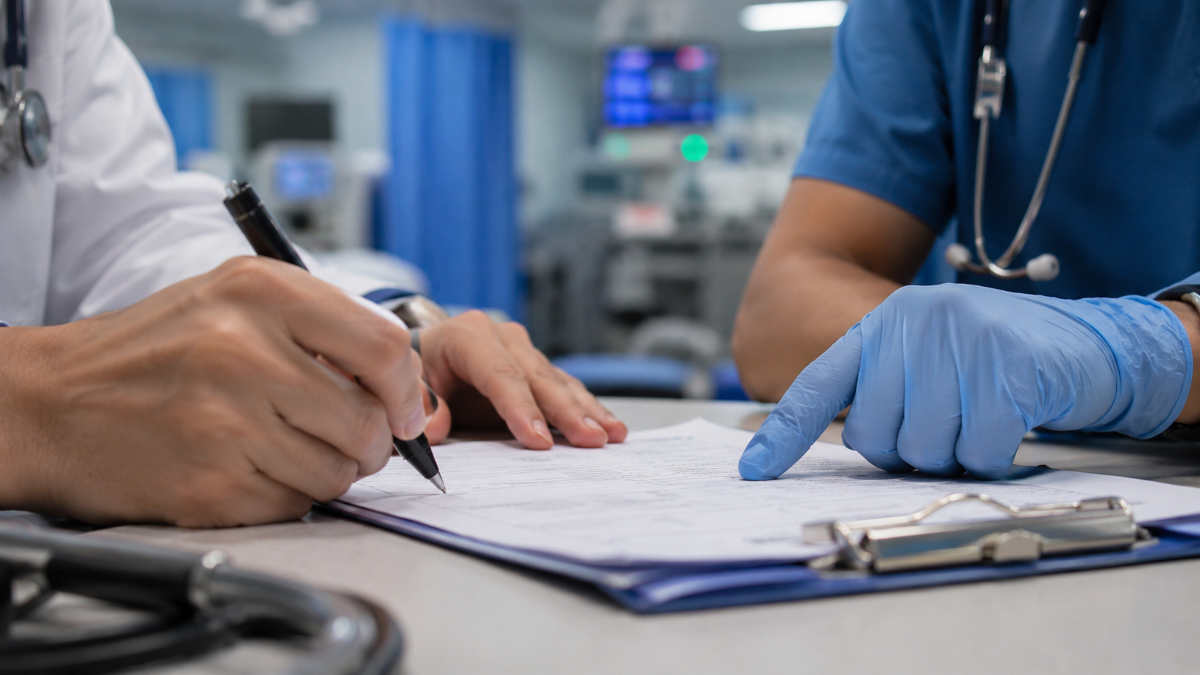
Emergency medicine has its own vocabulary: precise and functional. Every term describes a process, a structure or a skill that can affect the clinical outcome of a treatment. Triage, boarding, time-critical care, POCUS and so on name some of the most important tools in an emergency physician's clinical reasoning. This glossary brings together the main terms, explained in the context where they're actually used.
The Patient in the Emergency Department
From the moment a patient enters the DEA to the moment they're discharged or transferred to a ward, their journey passes through a series of carefully defined assessments and procedures. These are the terms that describe that journey.
Triage
Triage comes from the French trier, meaning to sort. It's the process of assessing and classifying patients on arrival at the emergency department based on clinical severity, not order of arrival. In Italy it's carried out by trained nursing staff under medical supervision, following standardised protocols. The most widely used system assigns five priority codes: red (immediate life threat, treatment within 0-10 minutes), orange (high urgency, within 15 minutes), yellow (medium urgency, within 30-60 minutes), green (urgency that can wait, within 120 minutes), and white (non-urgent). Triage isn't a final clinical decision: it's a priority assessment that can be revised at any time. It's one of the procedures The Pitt portrays with the greatest accuracy.
Stabilisation
Stabilisation is the set of clinical interventions that bring a critical patient to a condition safe enough for transfer to a ward, operating theatre or intensive care unit. It isn't definitive treatment: it's the first step in the pathway. It includes monitoring vital functions, managing pain, and starting specific treatment for the most urgent conditions.
Time-Critical Care
Time-critical care is the management of time-dependent conditions, where every minute between symptom onset and treatment affects the clinical outcome. An acute myocardial infarction treated within 90 minutes of the occlusion has a significantly better prognosis than one treated after two hours. The same is true for ischaemic stroke, sepsis and major trauma. Emergency medicine is built around this principle: recognising early and treating fast is the emergency physician's central skill.
Boarding
Boarding is the phenomenon whereby patients who need to be admitted to a ward remain in the emergency department while they wait for a bed to become available. It's one of the main drivers of overcrowding in Italian and European DEAs: patients in boarding occupy space and resources, slow down patient flow, and pull the emergency physician away from their core role.
OBI: Osservazione Breve Intensiva
An OBI (short-stay intensive observation unit) is the area of the DEA dedicated to observing and clinically reassessing patients who don't need immediate admission but can't be discharged without further monitoring. Standard OBI stays last 6-24 hours. It helps avoid inappropriate admissions and catch clinical deterioration early.
From the Field to the Hospital
The Italian emergency system extends out into the field, with a network of vehicles and facilities that intervene before the patient even reaches hospital. Here are the terms that describe that network.
DEA: Dipartimento di Emergenza e Accettazione
The organisational structure that brings together the emergency department, emergency medicine and short-stay intensive observation (OBI) into one coordinated system. There are two levels: level I DEAs serve catchment areas of 150,000-300,000 people and cover the most frequent emergencies; level II DEAs, found in major hospitals, also have cardiac surgery, neurosurgery, vascular surgery, and paediatric and neonatal intensive care. The highest classification is the Centro di Emergenza ad Alta Specialità (EAS). San Raffaele Hospital (IRCCS) in Milan, with more than 170 emergency department admissions a day, falls into this category.
EAS: Centro di Emergenza ad Alta Specialità (High-Specialty Emergency Centre)
The highest classification in the Italian hospital emergency system. An EAS has every specialist discipline needed to manage the most complex emergencies, and it receives the most severe cases from the surrounding area. In Italy, EAS centres are limited in number, concentrated in the country's main metropolitan hospital hubs.
118
Italy's out-of-hospital emergency healthcare service can be reached on 118 or, in regions where it's active, through the single European emergency number 112. The 118 dispatch centres coordinate the deployment of emergency vehicles and manage communication between the field and hospital DEAs. Vehicles on the ground vary by level of care: the basic ambulance is staffed by trained rescue personnel; the rapid-response car, or Mezzo di Soccorso Avanzato (MSA, advanced life support vehicle), carries a doctor on board and is equipped to start advanced treatment at the scene. In Lombardy the network is coordinated by AREU, the Azienda Regionale Emergenza Urgenza (Regional Emergency Healthcare Agency), through the Sala Operativa Regionale (SOREU, Regional Dispatch Centre) and the Centrale Medica Integrata (CMI, Integrated Medical Control Room). The emergency physician can work in the dispatch centres or on the advanced vehicles.
HEMS: Helicopter Emergency Medical Service
The HEMS helicopter rescue service brings a specialised doctor and nurse to the scene, equipped for advanced patient stabilisation. Helicopter rescue is used when ground transport would be too slow or the location is hard to reach. Emergency department experience alone isn't enough to work in HEMS: it requires specific certified training through the HEMS course, covering modules on trauma, in-flight airway management, and rendez-vous procedures. Once certified, continuing training is mandatory every six months.
SSM: Scuole di Specializzazione in Medicina
SSM is the annual national exam through which Medicine and Surgery graduates gain access to Italian residency programmes. It's a single test for all candidates: based on the score achieved, each candidate chooses their preferred combination of specialty and university. Those ranked higher choose first. For emergency medicine, with almost half of positions left unassigned every year, there's plenty of room to choose.
The Emergency Physician's Skill Set
Training in emergency medicine includes a set of procedures and certifications with standardised international naming. These are the most important ones.
POCUS: Point-of-Care Ultrasound
POCUS is an ultrasound scan performed directly at the patient's bedside by the emergency physician, in real time, during clinical assessment. It doesn't replace traditional radiology ultrasound, but complements the physical exam by providing immediate diagnostic information. It's useful for abdominal trauma with suspected internal bleeding (eco-FAST), shock of unclear origin, acute chest pain, and severe breathlessness. It's considered a standard skill for emergency physicians.
Airway Management
Airway management is the ability to secure and maintain a patent airway in a patient who can't breathe unassisted or is at risk of losing consciousness. It includes orotracheal intubation, meaning the insertion of a tube through the mouth into the trachea, connected to a mechanical ventilator, and the management of what's known as a difficult airway: cases where standard intubation isn't feasible due to anatomical variation or the patient's clinical condition. Airway management is one of the mandatory procedural skills in emergency medicine residency.
ACLS: Advanced Cardiovascular Life Support
ACLS is the advanced cardiopulmonary resuscitation protocol developed by the American Heart Association. It covers the management of potentially fatal arrhythmias, defibrillation, airway management, and the administration of life-saving drugs. It's one of the most widely recognised training standards internationally.
ATLS: Advanced Trauma Life Support
ATLS is the standardised protocol for the initial management of the major trauma patient, developed by the American College of Surgeons. It follows a precise sequence of assessment and treatment: airway, breathing, circulation, disability, exposure. It's also known by the acronym ABCDE. It's the international reference certification for trauma management in the first hours and is part of the training curriculum in Italian emergency medicine residency programmes.