28 Jul, 2026
Emergency medicine has the second-highest number of residency positions of any medical specialty in Italy, and the Ministry of Health classifies it as a priority specialty for the national healthcare system. Yet in the 2025 national exam, 45% of those positions went unfilled. Of 976 training contracts available across 36 Italian schools, 439 remained unassigned. In 2024 the shortfall was worse: 70% of positions stayed vacant.
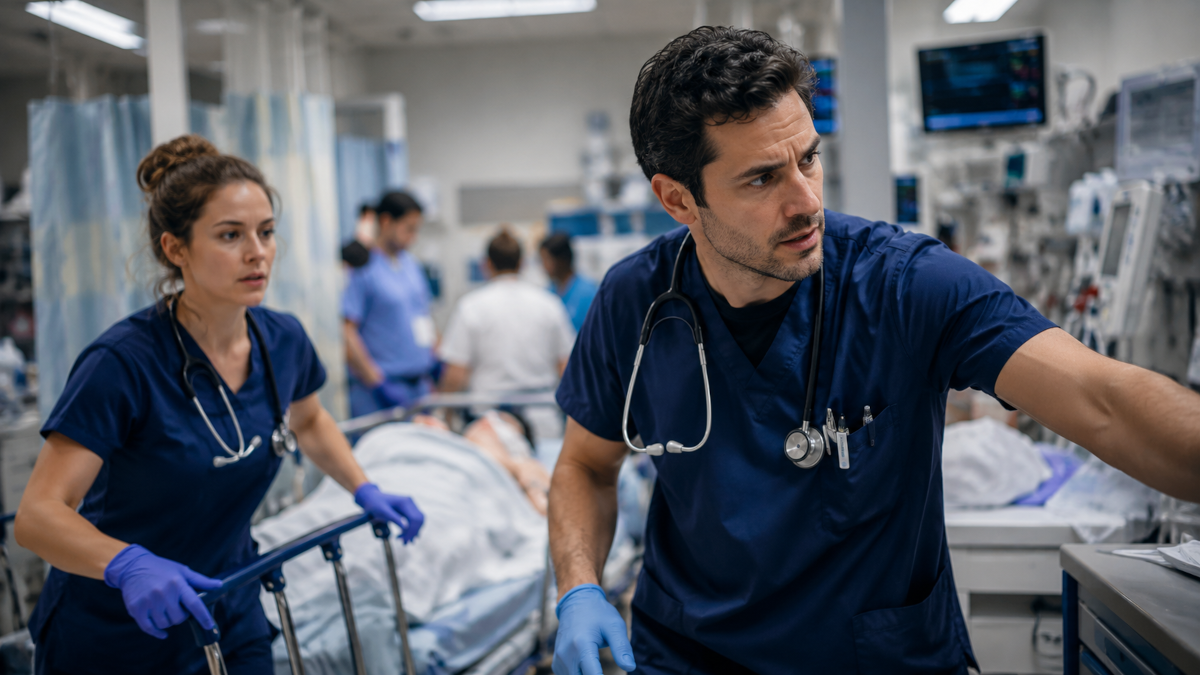
In 2025, The Pitt, the HBO series set in a Pittsburgh emergency department, won five Emmys, including Outstanding Drama Series. It won over the medical community for one specific reason: among recent medical dramas, it portrays emergency medicine with the highest degree of accuracy, detailing triage protocols, showing how much real-time decisions matter, and exposing chronic understaffing and the fraught relationships with the most difficult patients.
The Pitt's real achievement goes beyond the awards. It showed, concretely, what it means to work as an emergency physician, the only specialist who always starts from the symptom rather than a diagnosis, because there usually isn't one yet. Every shift is a sequence of clinical pictures built from scratch, on patients of any age and condition, with limited resources and little time.
Fifteen Hours on Shift: the Emergency Physician's Job Up Close
The show's format is its most radical feature: each episode covers one real hour of a single 15-hour shift, with no time jumps, an almost imperceptible score, long unbroken takes on a 360-degree set, and editing built to feel continuous. The viewer doesn't watch the emergency department from outside; they live it alongside the staff.
The accuracy goes beyond the aesthetics, though. The technical dialogue was written with input from real physicians, including Joe Sachs, an emergency doctor and former member of the ER writing team, and it shows. The procedures are correct, the decision-making pace is right, and the way doctors reason under pressure is recognisable to anyone who has worked in an emergency department. That's why the medical community has embraced it as its own.
For the same reason, Hollywood, Health & Society, the Norman Lear Center programme that has studied the relationship between television fiction and public health behaviour for over two decades, gave the series its Culture of Health Award. «The Pitt's success is a powerful reminder that stories can prioritise accuracy, highlight systemic challenges through authentic characters, spark emotion, and inspire real-world action, all without sacrificing entertainment value», says Erica Rosenthal, director of research at the centre.
There's one thing the series doesn't show: the path that leads to becoming that doctor. Five years of residency across wards and settings that have little in common with each other. The decisiveness that looks instinctive on screen can only be built through practice.
What an Emergency Physician Actually Does
Almost every medical specialty has a defined scope: an organ, a system, an age group. Emergency medicine doesn't. The emergency physician builds the clinical picture from scratch for whoever walks in, in any condition, with no option to wait. The job isn't to cure in the traditional sense, but to stabilize, assess, and start the treatment pathway.
This is what's known as time-critical care: managing time-dependent conditions where every minute between symptom onset and treatment affects the clinical outcome. Acute myocardial infarction, ischemic stroke, sepsis: early treatment measurably changes the prognosis. Emergency physicians perform or supervise triage, take a rapid history, order and interpret tests in real time, carry out invasive procedures such as intubation, central vascular access and Point-of-Care Ultrasound (POCUS), and coordinate with specialists to define the patient's care pathway.
Beyond the emergency department, emergency physicians also work in out-of-hospital emergency care: ambulances, helicopter rescue, the 118 dispatch service (Italy's equivalent of 911), and mass-casualty management. It's an operational range The Pitt only partly captures, since the show is set entirely inside the hospital.
How to Become an Emergency Medicine Specialist in Italy
Admission runs through the national SSM exam (Scuole di Specializzazione in Medicina), a single test for every Italian candidate that produces one national ranking. Candidates with higher scores choose first from the available combinations of specialty and university. Because nearly half of emergency medicine positions go unfilled each year, candidates who choose it are admitted almost automatically, usually at their preferred location.
The programme requires progressive certification of procedural skills: advanced cardiopulmonary resuscitation, airway management and orotracheal intubation, central vascular access, and point-of-care ultrasound. Each procedure carries a minimum number of certified completions before residents can finish the programme.
Watching The Pitt while training to become an emergency physician is a different experience than watching it without that background, many emergency doctors say. They recognise the procedures, judge the clinical decisions, and notice when something is precise versus simplified for a general audience. The show stops being entertainment and becomes something closer to a set of clinical cases to debate.
UniSR's Emergency Medicine Residency Programme
UniSR's Emergency Medicine Residency Programme is directed by Prof. Paola Angela Maria Maffi. It's based at San Raffaele Hospital (IRCCS) in Milan, a Centro di Emergenza ad Alta Specialità (EAS, the highest-level emergency care centre in the Italian system) with more than 170 emergency department admissions a day.
The training includes a feature that sets this programme apart from many others. Alongside daily clinical practice shadowing emergency department specialists, residents train at UniSR's Simulation Lab on emergency scenarios, rehearsing the manoeuvres they will later perform on patients: airway management and non-invasive ventilation, central vascular access and percutaneous drainage placement, cardiac resuscitation, and minor first-level surgical procedures such as suturing superficial wounds. This simulation-based teaching translates into a hands-on approach that lets residents build autonomy progressively, while keeping a wide margin of safety.
Training also includes a regional component, part of the AREU programme (Regione Lombardia's emergency healthcare agency). Residents complete placements at the regional 118 dispatch centre (SOREU), the integrated medical control room, and on medicalised ambulances (Mezzo di Soccorso Avanzato). This is the part of the programme that takes future emergency physicians outside the hospital, into the field.
The training network extends beyond the main site at San Raffaele Hospital to affiliated facilities including Centro Cardiologico Monzino, the Vizzolo Predabissi Hospital (ASST Melegnano Martesana), and the San Marco and San Pietro polyclinics in the Bergamo area; these rotations are mandatory by law. Residents can also complete additional placements at the emergency department of Papa Giovanni XXIII Hospital in Bergamo, a level II DEA recognised for excellence in Lombardy and a trauma centre that also covers paediatric cases, and at Guglielmo da Saliceto Hospital in Piacenza, whose emergency department is considered an advanced model for emergency management and organisation. International placements have taken residents to Chicago, London and Paris; for humanitarian missions, residents have taken part in projects in Sierra Leone and Ethiopia with CUAMM, and in collaborations with Mediterranea Saving Humans.
Why Demand for Emergency Physicians is Structural
Data from the 2025 exam reveal a problem that recurs every year: of 976 available positions in emergency medicine, only 537 were filled, leaving 45% of places uncovered, despite the field having some of the lowest minimum entry scores in the entire exam. The documented reasons include night and holiday shifts, high exposure to critical situations, medico-legal risk, and boarding: the practice of managing patients waiting for an inpatient bed, which burdens emergency physicians with responsibilities that aren't theirs to carry.
Between 2019 and 2023, to cover the chronic staffing shortage, Italian emergency departments relied on locum doctors (medici gettonisti) at a total cost of 1.7 billion euros to the public system, without resolving the underlying problem. Starting in 2025-2026, the Ministry introduced a specific stipend increase for emergency medicine residents: about 160-200 net euros a month above the standard residency stipend.
The Pitt, now in its second season since January 2026, has brought these tensions to the screen: understaffing, budget strain, patients waiting for hours in hallways. It isn't only an American scenario. It's a snapshot of a healthcare system under pressure that touches every European emergency department, Italian ones included. Demand for emergency physicians isn't going to ease soon.
Why Choose Emergency Medicine
Emergency medicine isn't a specialty to choose by default. It requires a specific disposition: high tolerance for diagnostic uncertainty, interest in cross-disciplinary clinical work rather than depth in a single field, the ability to decide quickly under pressure, and a preference for team-based work in high-intensity settings.
The Pitt can work as a first filter. Fiction isn't reality, but if you watch the series and recognise, in how those doctors think under pressure, something you'd want to be able to do yourself, that recognition already tells you something useful. The next step is more concrete: talking to residents and attending physicians, spending a day shadowing, and understanding from the inside whether the specialty is the right fit.
Frequently Asked Questions About Emergency Medicine
How Long Is the Emergency Medicine Residency in Italy, and How Do You Apply?
The Emergency Medicine Residency Programme lasts five years. Admission runs through the national SSM exam (Scuole di Specializzazione in Medicina), a single test for all Italian candidates: based on the score achieved, each candidate chooses their preferred combination of specialty and university.
What's the Difference Between ‘Urgency’ and ‘Emergency’ in Medicine?
In medicine the two terms aren't interchangeable. An emergency is a condition with immediate risk to life that requires intervention within minutes. An urgent condition requires prompt treatment but not immediate action, meaning the patient can wait a limited time without serious risk of deterioration. Triage assigns each patient a priority based on exactly this distinction.
What Does Triage Mean?
Triage is the process of assessing and classifying patients on arrival at the emergency department based on clinical severity, not order of arrival. In Italy it's carried out by trained nursing staff under medical supervision, following standardized protocols. Patients are assigned a priority code, from red (immediate life threat) to white (non-urgent), which determines how quickly they're seen.
What Is a DEA and How Does It Differ From an Emergency Department?
DEA stands for Dipartimento di Emergenza e Accettazione (Emergency and Admission Department), the organisational structure that brings together the emergency department, emergency medicine, and short-stay intensive observation (OBI) into one coordinated system. Italy distinguishes between level I and level II DEAs, with level II covering the most complex disciplines: cardiac surgery, neurosurgery, vascular surgery, and paediatric and neonatal intensive care. San Raffaele Hospital (IRCCS) is classified as a Centro di Emergenza ad Alta Specialità (EAS), the system's highest category.
What Is POCUS, and Why Does It Matter in Emergency Medicine?
POCUS stands for Point-of-Care Ultrasound: an ultrasound scan performed directly at the patient's bedside by the emergency physician, in real time. It shortens diagnostic times and can avoid more invasive tests. It's used for abdominal trauma with suspected internal bleeding, shock of unclear origin, acute chest pain, and shortness of breath. It's now considered a standard skill for emergency physicians.
How Difficult Is It to Get into an Emergency Medicine Residency in Italy?
A large share of available emergency medicine positions often goes unfilled, and the field has some of the lowest minimum entry scores in the entire national exam. The difficulty isn't getting in, it's choosing: the specialty requires a specific disposition for working under uncertainty, pressure, and high case variability.
Written by

UniSR Communication Team
Thanks to the contribution of the various team members, the UniSR Marketing and Communications Service deals with the multiple communication areas of the University: news scouting, creation of news, audio and video, event organization, website management and institutional social media, drafting and publication of newsletters, support for institutional relations. The Service interacts with all the main stakeholders (students, teachers, technical and administrative staff, research community, territory) in order to support and potential communication (internal and external) of the initiatives related to teaching, research and public engagement.
Visit the author's page