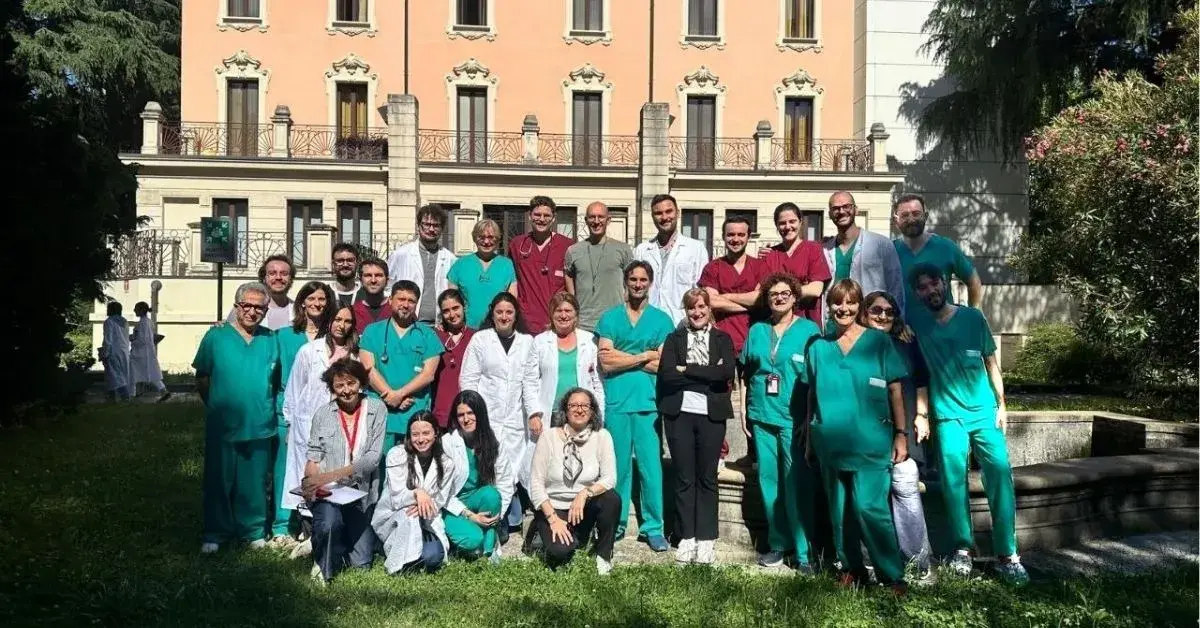
The Infectious Disease residency at Università Vita-Salute San Raffaele rests on one core principle: every resident gets the chance to do research starting in year one, paired one-to-one with an academic tutor. The Infectious Diseases Unit at IRCCS San Raffaele Hospital treats 5,000 patients living with HIV, the starting point for a clinical path that then branches into very different areas, from infectious disease emergencies to training at leading international centres. We spoke with Prof. Antonella Castagna, Director of the School of Specialization in Infectious and Tropical Diseases at UniSR.
How Research Works in the Infectious Disease Residency
From the first months, every resident works side by side with an experienced physician, who follows their progress and gradually introduces them to research. The tutor guides residents through writing their first abstract, then their first manuscript: over time, residents come to make a genuine contribution to the international literature. «I make a point of pushing young residents to write their first abstract», says Prof. Castagna. «By the end of the programme, we want them to already have a small publication record, a genuine advantage when it comes to interesting career opportunities».
Tommaso Clemente, a former resident at the school and now a physician, is first author of a position paper published in The Lancet HIV on low-level viremia in HIV infection: the persistence of low viral concentrations in the blood despite therapy. «I'm very pleased with what he achieved, not least because it's a good example of our method», Prof. Castagna notes. Recognition for residents' commitment also comes through the Myriam Maillard Award, presented every year on 1 December, World AIDS Day, to the best international abstract authored by one of the school's residents.
What the UniSR Infectious Disease Residency Covers
The first year focuses on inpatient wards and day-hospital care, building the foundations of clinical infectious disease practice. From the second year, the path branches out. The 5,000 HIV patients treated at San Raffaele Hospital represent a major training opportunity in their own right. At the same time, residents join staff physicians for consultations with other departments, around 5,000 a year, among the highest volumes in Italy for a single centre. At UniSR, the infectious disease specialist works alongside surgery, oncology and intensive care teams, setting antibiotic therapies and working through prescribing decisions with colleagues. The programme also covers the emergency department and acute care medicine: «For an infectious disease specialist, managing emergencies such as malaria, sepsis and meningitis is essential» Prof. Castagna explains.
Residents also work at Villa Marelli, the reference centre for tuberculosis, and all complete a placement in wound care at San Gerardo Hospital in Monza, rounding out their training in complex skin infections.
Among the most valuable experiences for professional growth is the six months residents spend at the Infectious Diseases Unit in Lecco. «It's a very different setting from a large research centre: there, residents learn to manage everything that comes through the door in a wide provincial catchment area. San Raffaele Hospital sees greater case complexity, while in Lecco residents handle incoming cases directly, and it's important to gain experience in a less structured environment» Prof. Castagna says. A further placement, in paediatrics at the San Donato Group's Bergamo hub, adds to this preparation, building familiarity with infectious diseases typical of childhood.
Every Wednesday afternoon is set aside for scientific training, through seminars and lectures dedicated to residents. During these sessions, faculty open the floor to direct discussion with residents, gathering their feedback on the programme.
The Year of Training Abroad
Residents who choose to can spend the third year of training abroad, a structured option supported by UniSR. «It's an experience that really opens your mind», Prof. Castagna explains, «and the school actively supports it, because residents who go abroad come back with skills that benefit the Campus San Raffaele».
Destinations vary widely. Six months in Uganda and six months in London are radically different experiences, but each teaches something the other can't: the first means working with limited resources and endemic tropical diseases, the second means encountering advanced healthcare systems and international research networks. The return isn't only personal. Every resident who comes back from abroad brings perspectives, contacts and skills that benefit the whole school.
The Skills Tomorrow's Infectious Disease Apecialist Will Need
Covid made clear the role infectious disease specialists play in responding to large-scale health crises. But the picture doesn't end with coronaviruses: Ebola, hantavirus and other emerging viruses are all part of the risk profile every infectious disease specialist must be ready to address.
«We need to be trained on multiple fronts, ready to give well-reasoned, wide-ranging responses», Prof. Castagna notes, «and at the same time the role of antimicrobial stewardship consultant is growing: the physician who, on the wards, sets antibiotic, antiviral and antifungal therapies and promotes rational antibiotic use. It's already an established role in many European countries, and the Italian health system is gradually moving in that direction too». Antimicrobial resistance, the ability of microorganisms to survive the drugs meant to eliminate them, accelerated by the excessive or improper use of antibiotics, remains one of the most widely discussed health risks in the literature.
«Diagnostic techniques are also changing very fast: infectious disease specialists will find themselves building and interpreting artificial intelligence algorithms to support clinical decisions», Prof. Castagna adds. Anyone starting their residency today will work in a diagnostic landscape radically different from today's.
Climate Change and Emerging Infectious Diseases
The UniSR infectious disease residency has already added the relationship between climate change and infectious disease to its curriculum, reflecting a broader focus on global health: the expanding range of the tiger mosquito, locally acquired cases of dengue, chikungunya and West Nile virus, and shifts in the distribution of animal reservoirs are all subjects residents need to know and study.
«The first connection between climate change and infectious disease was drawn in the New England Journal of Medicine», Prof. Castagna recalls. It described an outbreak aboard a cruise ship in Alaska in 2005, caused by Vibrio parahaemolyticus: a bacterium that had found an unprecedented reservoir in oysters at that latitude, made possible by rising water temperatures (McLaughlin JB et al., N Engl J Med 2005;353:1463-1470). As temperatures change, animal reservoirs and vectors change too, and epidemiology shifts as a result.
Understanding these dynamics, from vector distribution to interspecies transmission mechanisms, is now part of infectious disease training. «Climate change will certainly be closely tied to shifts in infectious disease epidemiology, and it's a subject of study for the infectious disease specialists of the future», Prof. Castagna concludes.