25 Nov, 2026
What does it take to succeed in a neurosurgery residency in Italy? For Professor Pietro Mortini, who has directed the Residency Programme in Neurosurgery at Vita-Salute San Raffaele University (UniSR) since 2008, the answer has little to do with grades or the admission test. Becoming a neurosurgeon takes natural aptitude, dedication and the desire to take on a hands-on training programme that tests residents from their first months.
What It Bakes to Become a Neurosurgeon
According to Mortini, passing the admission test is only the first step, because some requirements are tested mainly in practice. The most immediate is language. Neurosurgical literature is written and read almost entirely in English, and UniSR neurosurgeons have published only in English for about twenty years.
Then there is the ability to make sense of data. The technologies used in theatre, from stereotactic radiosurgery to neurostimulation, generate large amounts of information that has to be interpreted: «Residents also need a very good knowledge of computer science, because the latest neurosurgical technologies require an aptitude for interpreting and managing vast amounts of data».
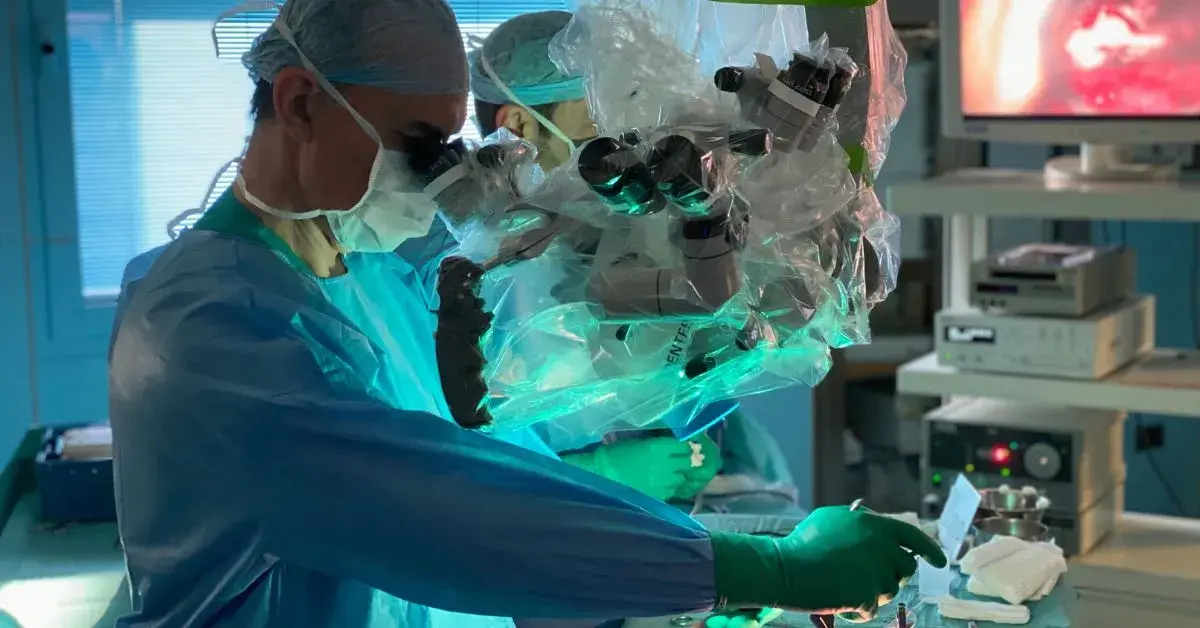
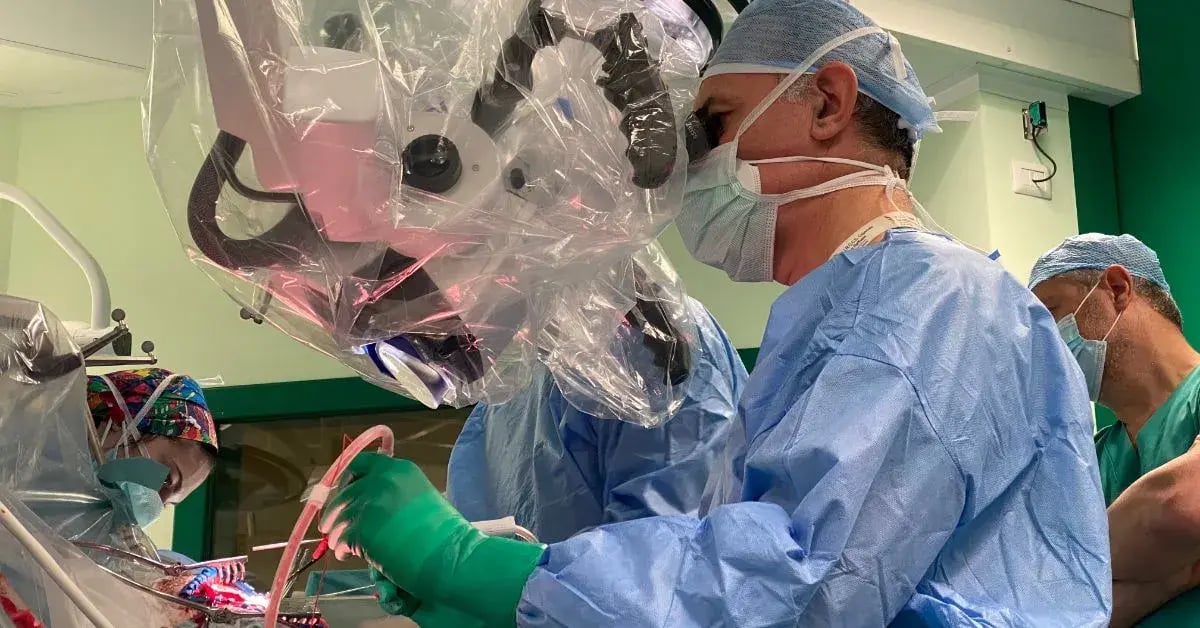
Motor coordination is an obvious requirement, but one worth taking seriously. It is no coincidence that several members of Mortini’s staff have years of sporting experience. «Surgeons who operate with optical magnification systems in very small surgical fields, like those of the brain, work in uncomfortable positions for hours, and manual dexterity cannot be learned overnight». Neurosurgeons must be able to make precise movements and have excellent control of their own bodies.
Residents who join the UniSR programme without ever having seen a neurosurgical operation start at a disadvantage, Mortini adds. «It is highly advisable to have had some previous experience in this discipline, for example while working on a degree thesis».
These requirements rest on a broader premise. «You don’t choose neurosurgery as just one specialty among many», Mortini explains. «When neurosurgeons operate, their impact on the patient is the greatest of any medical discipline, because of how long and how deeply each operation affects the life of the person who undergoes it. You need to be aware of this from the start, or you risk running into difficulties. People who don’t know what lies ahead often switch specialty after a short time». The professor sees this as a central point, because neurosurgeons must be deeply dedicated to their work rather than simply clocking in and out.
The Operating Theatre as a Textbook
Those enrolled in UniSR’s neurosurgery residency programme can rely on a textbook published by Mortini’s team in 2025, based on thirty years of clinical work and also available as a PDF. This book, however, is only a starting point. «Neurosurgery changes so fast that, on the theoretical side, the only tools for really learning it are up-to-date articles in the scientific literature. Books are already three years out of date», Mortini explains. «Real learning, then, can only come through practice. Talk to a great chef and you’ll find he didn’t take his recipes from a book. Observing and practising surgery is the only way to become a good neurosurgeon. At Vita-Salute San Raffaele University, learning by working alongside experienced surgeons is the cornerstone, one of the pillars of the school», he stresses.
What does this mean in practice? The first year of the neurosurgery residency is entirely clinical. For the first six months, residents follow patients and learn safety procedures, before they even enter the operating theatre. Only then does their gradual involvement in surgery begin, initially as first or second assistant, then with growing responsibility based partly on each resident’s skill.
How the UniSR Neurosurgery Residency Has Changed Since 2008
When Mortini became director, succeeding Professor Giovanelli, his respected mentor, he built on the programme’s already solid foundations and steered it towards a model that differs from the traditional one, at least in Italy. The aim was to bring the programme closer to the UK and US residency model.
The result is a UniSR neurosurgery residency that, in terms of resources, is among the largest in Italy under a single director: seventy beds, almost 400 publications in high-impact-factor journals and a training network that stretches from the north to the south of the country, with agreements in several regions. Unlike many academic neurosurgery departments, which often have no link to an emergency department, UniSR’s programme covers the full spectrum of the discipline, from elective cases treated with advanced technologies to emergency care.
In the postgraduate medical training model used in the UK and the US, residents become part of ward life from day one, with real clinical responsibilities rather than a purely observational role. They take on these responsibilities gradually and in a structured way, year after year, until they reach full independence. Residents move up a grade as they demonstrate their competence.
For Mortini, the proof that the model works is one of his former trainees, now a consultant (the most senior grade of hospital doctor in the UK) in Sheffield, England. «Our colleague came to the San Raffaele Campus straight after graduating, and the environment in which he trained meant that, when he decided to move to a different setting, he noticed no difference at all», Mortini recalls.
Neurosurgery Residency in Italy: Research and Training Abroad
Throughout their training, residents can observe cutting-edge procedures first-hand and take part in the research projects of UniSR’s neurosurgery department. «A resident who joins us learns the ABCs of neurosurgery and also sees procedures that are performed in very few centres in the world», he notes. Mortini’s team, for example, is one of the very few that perform spinal cord stimulation for post-traumatic injuries, and carried out its first implant in 2023. Two years later, the team reported positive results in two patients in Science Translational Medicine. In May 2025 it described in Med (Cell Press) the case of a man who regained the ability to walk a kilometre unaided after a severe spinal cord injury, a story covered by Corriere della Sera, Il Sole 24 Ore, Sky TG24 and other national and international media. What began as an experimental protocol for 10 patients has grown to 26 patients treated in two years, a remarkably fast pace in experimental neurosurgery.
This result is the work of a multidisciplinary team. The MINE Lab, a joint laboratory set up by UniSR and the Sant’Anna School of Advanced Studies in Pisa and led by Mortini and Professor Silvestro Micera, is where neurosurgeons and bioengineers work side by side to tailor treatment to each patient. «This joint laboratory is a truly unique asset», Mortini says, pointing to the University of Pittsburgh, where the only similar initiative is still being set up.
International experience is an integral part of the neurosurgery residency at UniSR, as the former trainee’s path to Sheffield shows. Most residents spend between six months and a year at institutions abroad, through partnerships that include George Washington University, where Mortini is still a Clinical Professor, and leading centres in Spain and other Western countries. Residents who want to train elsewhere can do so easily, provided they submit a clearly defined training plan approved by the programme board.
Written by

UniSR Communication Team
Thanks to the contribution of the various team members, the UniSR Marketing and Communications Service deals with the multiple communication areas of the University: news scouting, creation of news, audio and video, event organization, website management and institutional social media, drafting and publication of newsletters, support for institutional relations. The Service interacts with all the main stakeholders (students, teachers, technical and administrative staff, research community, territory) in order to support and potential communication (internal and external) of the initiatives related to teaching, research and public engagement.
Visit the author's page