
25 Jul, 2025
Since 2023, the Master's degree in Psychology carries direct professional accreditation: the Supervised Clinical Practicum (Tirocinio Pratico Valutativo, TPV), 20 ECTS credits of supervised clinical work, is built into the degree itself. How that placement is structured matters.
At UniSR, it takes place at IRCCS Ospedale San Raffaele and IRCCS San Raffaele Turro, beginning in the first year of the Master's.
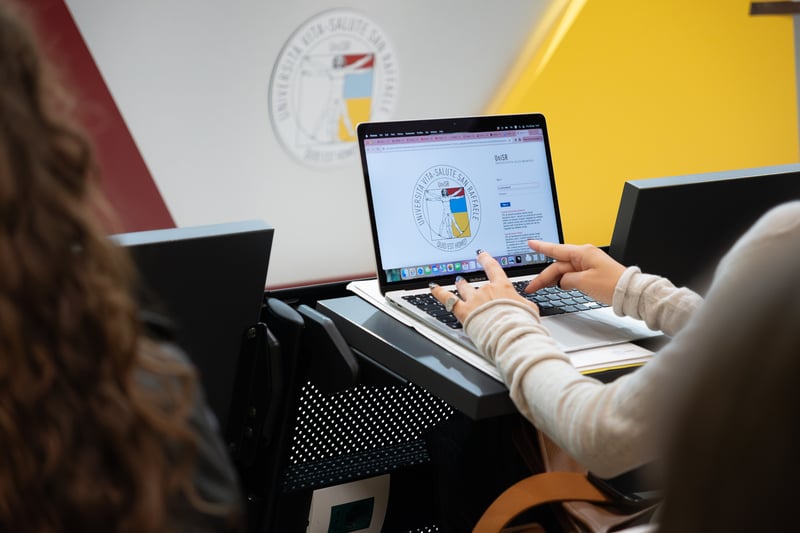
Clinical placement during the Master's, not after
IRCCS Ospedale San Raffaele and IRCCS San Raffaele Turro are two hospital institutions recognised by the Italian Ministry of Health for clinical excellence and research. They are integrated with the Faculty, not merely affiliated with it. The placement is one of the first opportunities to build a professional network, to choose a clinical specialisation with real experience behind the decision, and to orient a career well before the final dissertation.
The Master's degree in Psychology (class LM-51) confers direct accreditation: the traditional State Examination no longer exists. Accreditation is obtained on graduation, through two components embedded in the degree: the TPV described above, and the Supervised Practical Examination (Prova Pratica Valutativa, PPV), taken as part of the graduation session. Graduates are immediately eligible to register with the Italian Register of Psychologists, Section A.
The Bachelor's degree in Psychological Sciences and Techniques, by contrast, does not confer accreditation for the title of psychologist, but allows registration with Section B of the Register. That credential covers areas such as personnel selection, educational and vocational guidance, and research, but does not include clinical diagnosis or psychotherapy.
The Bachelor's: building the foundations
The Bachelor's degree in Psychological Sciences and Techniques runs over three years, is worth 180 ECTS credits, and has selective admission (numero chiuso). From the first year, 10 ECTS credits are dedicated to professional activities: practical labs in Psychology of Perception, Psychophysics, and Group Dynamics, alongside modules in Professional Orientation and Bioethics, held partly in the research laboratories and clinical facilities of Ospedale San Raffaele.
The programme follows a clear progression: the first year builds epistemological and methodological foundations; from the second year, teaching moves into applied areas including neuroscience, social psychology, developmental psychology, and clinical and dynamic psychology. The Bachelor's prepares students for any psychology Master's programme in Italy or Europe, and leads naturally to the Faculty's own postgraduate offerings.
.jpg?width=800&height=533&name=Psicologia_UniSR%20(2).jpg)
Two Master's programmes in Italian, one in English
After the Bachelor's, three distinct pathways open. The Master's in Psychology, with selective admission, taught in Italian, offers two tracks built on a shared principle: every clinical intervention must be grounded in scientific evidence, not theoretical tradition or individual clinical preference. This is the Evidence-Based Psychology approach, which at UniSR shapes both teaching and hospital placement.
Clinical Psychology trains for direct patient work: diagnostic assessment, psychological support, interventions with individuals, couples, and families, integration with psychiatry, work in mental health services, schools, and forensic settings.
Neuroscience focuses on neuropsychological assessment and cognitive rehabilitation, with a stronger research component: experimental psychology, cognitive neuropsychology, functional neuroimaging, aphasiology. Career paths lead to research laboratories and neurology wards.
The third Master's, Cognitive Psychology in Health Communication, is delivered entirely in English in collaboration with the Università della Svizzera Italiana (USI). It combines cognitive psychology, research methodology, and strategic communication in healthcare. Graduates go on to work in international organisations, academic institutions, pharmaceutical companies, and public health agencies. This is a programme that does not exist in the majority of Italian psychology Master's offerings.
After the Master's: specialisation schools and doctoral programmes
Psychotherapy specialisation schools, which run for four years and are required for anyone wishing to practise psychotherapy, are numerous across Italy and differ by theoretical orientation: cognitive-behavioural, psychodynamic, systemic-relational. UniSR offers two internal schools, in Clinical Psychology and Neuropsychology, with direct continuity from the Master's.
Those oriented toward research can apply to the PhD in Cognitive and Behavioural Sciences: a three-year programme to develop an original research project, with access to academic positions and international research centres. Options are wide: doctoral programmes in psychology and neuroscience are active at many Italian and international universities.
Employment data: why the curve takes time to read
According to the 2025 AlmaLaurea Report, psychology Master's graduates record an employment rate of 60.7% one year after graduation. The figure has a structural explanation: many graduates continue with post-graduation training.
Five years after the Master's, the psychology cohort shows a rise of +45.4 percentage points: the highest increase among all Master's subject groups. The reason lies in the structure of the profession: the four-year psychotherapy specialisation school is a required step for those who intend to work in clinical settings, and it is the transition that consolidates professional identity and opens the most qualified career paths.
For those looking toward international organisations
In collaboration with the University of Bergamo, the Faculty of Psychology of Vita-Salute San Raffaele University offers the Bachelor's degree in Political Science and Global Strategies, which combines psychological training with tools from political science and international studies. The programme is designed for those who want to work in international organisations, the non-profit sector, or diplomatic institutions, bringing to their career a grounding in human behaviour that legal or political science training alone does not provide. The Master's in Geopolitics, Economics and Global Strategies completes the pathway.
Frequently asked questions
Does the psychology Master's confer professional accreditation?
Yes. The Master's degree in Psychology (class LM-51) carries direct accreditation: the traditional State Examination is no longer required. Accreditation is obtained on graduation, through two components built into the degree: the Supervised Clinical Practicum (TPV, 20 ECTS credits, completed during the degree) and the Supervised Practical Examination (PPV), taken at the graduation session. Graduates are immediately eligible to register with the Italian Register of Psychologists, Section A. The Bachelor's in Psychological Sciences and Techniques allows registration with Section B, covering specific application areas but excluding autonomous clinical practice.
What is the Supervised Clinical Practicum?
The TPV (Tirocinio Pratico Valutativo) is a mandatory training component introduced by the reform of the psychology professions (Ministerial Decree 654/2022): 20 ECTS credits of supervised clinical placement, to be completed during the Master's. At UniSR it takes place at IRCCS Ospedale San Raffaele and IRCCS San Raffaele Turro from the first year of the programme. Students transferring from another institution who have already completed equivalent activities during the Bachelor's may apply for partial recognition.
How does admission to the psychology Master's at UniSR work?
The programme has selective admission; places are set annually by the Faculty Council. Admission is based on qualifications; there is no written entrance test. Applications are accepted in two rounds: spring and autumn.
How do you become a psychotherapist after a psychology degree?
Practising psychotherapy requires a Master's degree in Psychology and a four-year psychotherapy specialisation, completed at a university or accredited private school. UniSR offers specialisation programmes in both Clinical Psychology and Neuropsychology. The choice of theoretical orientation — cognitive-behavioural, psychodynamic, systemic, or others — is made at the point of enrolment in the specialisation school.
What is the difference between the Clinical Psychology and Neuroscience tracks?
Both share the same theoretical foundation in Evidence-Based Psychology and include the hospital TPV. The difference lies in professional orientation: Clinical Psychology trains for direct patient work, including diagnosis, psychological support, and interventions in hospital, school, and forensic settings. Neuroscience focuses on neuropsychological assessment, cognitive rehabilitation, and research, with career paths in laboratories and neurology wards. The choice depends on where you want to work, not on the difficulty of the programme.
What does the Neuroscience track of the psychology Master's cover?
The Neuroscience track of the Master's in Psychology focuses on the relationship between brain and behaviour, with particular attention to neuropsychological assessment and cognitive rehabilitation. It is well suited to those who want to work with patients affected by brain injury, neurodegenerative conditions, or acquired lesions. Career paths include hospitals, rehabilitation centres, research laboratories, and facilities specialising in clinical neuropsychology.
What distinguishes UniSR's psychology Master's?
The TPV begins in the first year of the Master's, in IRCCS hospital facilities that are integrated with the Faculty, not merely affiliated. The specialisation schools in Clinical Psychology and Neuropsychology are internal to the university, providing direct continuity from the Master's. Selective admission ensures a close relationship with teaching staff and direct access to the clinical and research facilities of Ospedale San Raffaele.
Can you do a PhD after a psychology degree?
Yes. UniSR's PhD in Psychology runs for three years and involves developing an original research project, building advanced methodological skills in study design, data analysis, and academic writing. On completion, opportunities open in universities and national and international research centres. For those oriented toward an academic career or applied research, it is the natural step after the Master's.
Written by
Valentina Tobia
Valentina is a psychologist, with a PhD in Experimental Psychology, Linguistics and Cognitive Neuroscience; since 2019 she has been a researcher at the UniSR Faculty of Psychology. She deals with learning processes in preschool and school age, both considering the typical development and in relation to specific learning difficulties and disorders. She also does research in the field of school well-being and the effects of stressors in the school context. She carries out clinical activities at the Development Psychopathology service of the San Raffaele Turro Hospital and collaborates with various schools as a school psychologist and trainer.
Visit the author's page