28 May, 2026
Death enters caring professions in different ways and at different moments. In university curricula, however, grief rarely finds space as a subject addressed directly. A group of UniSR students decided to propose a structured discussion with their professors on the topic of death — and what emerged surprised even those who had organised it.
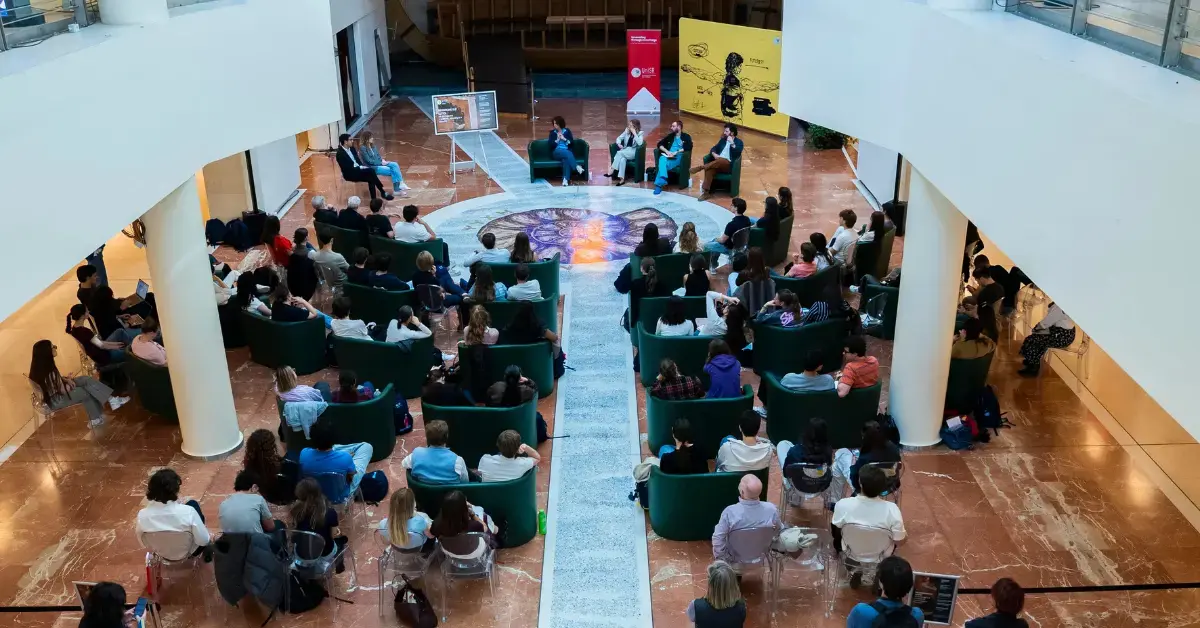
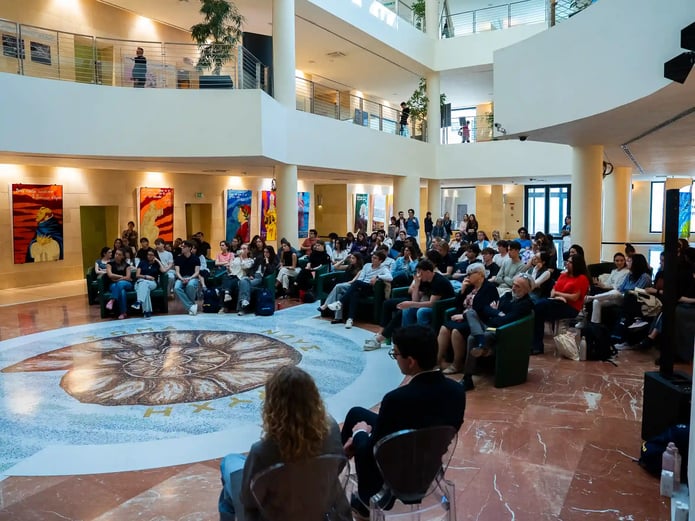
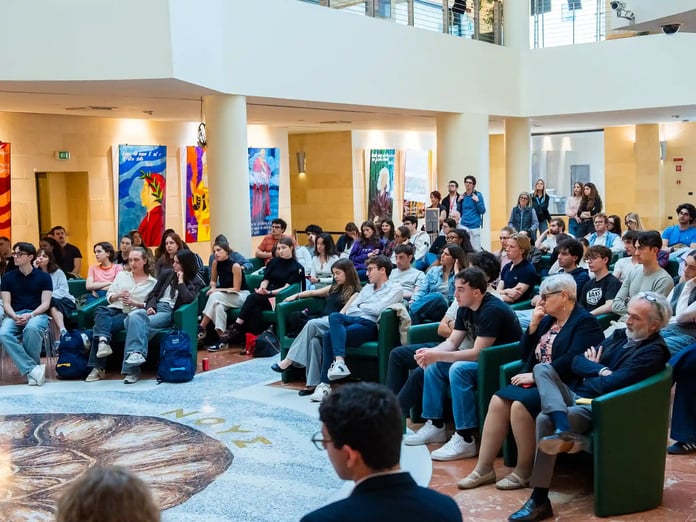
«We had to bring in extra chairs at the last minute» recalls Alberto Carluccio, President of the UniSR Student Council and one of the event’s organisers. «Turnout was much higher than we had expected». That is not a minor detail: it speaks to a need that exists, even among the youngest students.
A Conversation on Grief: Three Disciplines, One Table
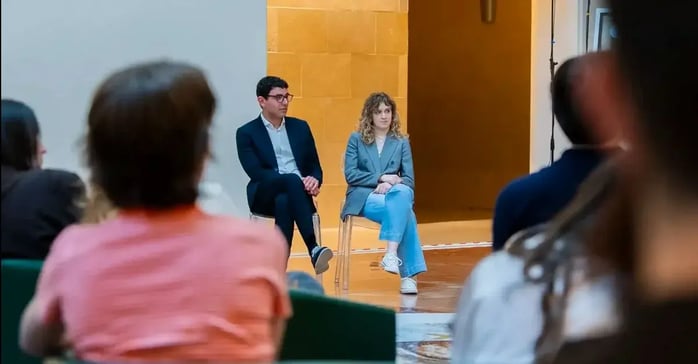
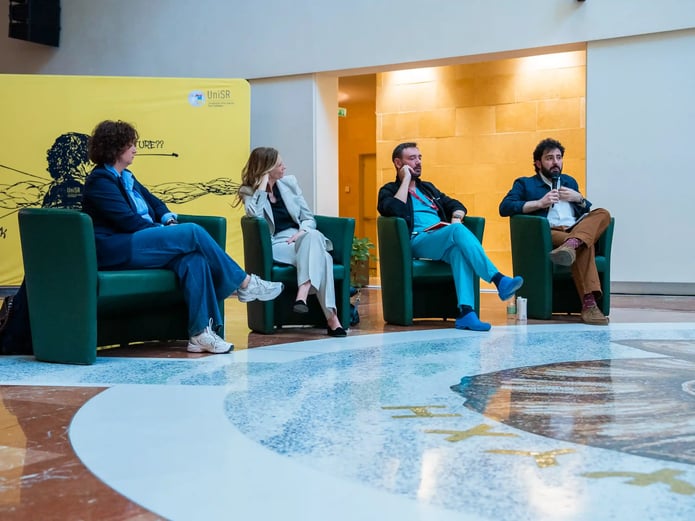
The event, promoted by Alberto Carluccio and Carlotta Leoni, representative of the Faculty of Psychology, and moderated by Prof. Anna Ogliari, brought together three faculty members from three different disciplines: Prof. Serena Borroni (psychology), Prof. Giacomo Monti (medicine and surgery), and Prof. Giacomo Petrarca (philosophy). The question at the centre: how does grief, personal and professional, intersect with the daily practice of those who work in direct contact with the suffering of others.
«Asking questions about grief is delicate: there is emotion involved, the discomfort of exposing yourself in front of everyone» Carluccio notes. «That is precisely why the conversation mattered. The speakers started from very broad questions, and each found their own direction, which turned out to be the right one. It allowed us to look at the topic from different angles, each brought by a different faculty».
When Personal Loss Enters Clinical Practice
Prof. Monti, who works in a ward where approximately 35% of patients die, used a visual metaphor to describe what happens when a clinician’s personal history intersects with professional demands. «It is like looking at a figure against a background» he explained. «The background is made up of personal experience: the family losses, the relationships, the events that have shaped each of us over time».
That background does not disappear. It changes, accumulates. What can be trained, and what Monti considers a component of clinical maturity, is the ability to shift focus: to move attention away from one’s own story and toward the patient in the foreground, their family. This does not mean erasing lived experience. It means learning, over time, to integrate it into the work.
Redefining the Goals of Care in the Face of Death
This kind of training matters also for what Monti calls the redefinition of care objectives. In contexts where recovery is not always possible, shifting focus from survival to the reduction of suffering allows the clinician to maintain a sense of efficacy even in the most difficult situations. «Redefining objectives may sound abstract» he acknowledged, «but it is actually very concrete: moving care from cure to pain reduction, to greater personal autonomy, to the dignity of the person, this allows the physician to set more achievable goals, even when survival is no longer an option».
Grief and Psychological Practice: When Personal Pain Enters the Therapy Room
Prof. Borroni approached the question from a psychological perspective, introducing the concept of emotional availability: the capacity to hold the patient’s mind within one’s own. It is a foundational requirement of the therapeutic relationship and one of the first things a personal loss can compromise.
«Grief can clearly make us less available in this sense» Borroni explained. «It is a universal experience, something that touches all of us. But it is also a highly individual process, and it must be respected». The literature describes an oscillatory pattern: moments of immersion in pain, alternating with moments in which attention can shift to the other person. In professional practice, recognising this oscillation, and working with its rhythm rather than blocking it, is already a form of managing grief.
There is also the opposite risk: excessive identification with the patient, when a client’s story resonates too closely with one’s own. «Empathy means being able to live the patient’s experience, to feel what they feel, to see the world through their eyes — while holding the awareness that the experience belongs to them, not to us,» Borroni clarified. Maintaining that distinction is a competence built over time, through tools such as peer supervision.
Why Dealing with Death in Caring Professions Is So Hard to Talk About
Prof. Petrarca brought a different perspective to the conversation, turning the focus to language. The words we use to speak of death. like “passing”, “going”, “no longer with us”, are built to cover it, to avoid naming it directly. He illustrated this with a childhood memory: as a child, hearing the “disappearance” of the bishop’s brother announced in church, he had thought the man had got lost somewhere and had been disturbed by it. «Philosophy, from this point of view, could be described as a great exercise in dissimulation» Petrarca observed. For healthcare professionals, this dissimulation has practical consequences: they are often the ones who must name death for the first time to a patient or a family. Doing so requires a language, and an inner disposition, that cannot be improvised.
Petrarca recalled how philosophical tradition has often tried to defuse the fear of death by rationalising it, but that eliminating the fear, as Franz Rosenzweig observed from the trenches of the First World War, risks stripping away something essential from the way we perceive the world. A different position comes from Spinoza: think not of death as negation, but of life as affirmation.
Vulnerability in Healthcare: The Human Side That Textbooks Don’t Teach
What struck the students most was a thread that ran through all three presentations: every speaker shared a personal experience. Doubt, exhaustion, the sense of not having been enough in the face of someone else’s (or their own) suffering.
«What stayed with me was seeing the professors’ vulnerability: the fear of not feeling adequate, the worry of having made a mistake, even after years of practice,» commented Carlotta Leoni, one of the organisers. «And the fact that each of them shared something private».
Is it consoling to discover that professors, after so many years of practice and training, still feel the weight and the doubt?
«Yes» replied Alberto Carluccio. «Regardless of role, student or professor, the professions we are training for are seen as reference points, especially in healthcare. But it cannot always be that way, that everyone goes through moments of weakness. Seeing that human side, realising that every person is, by definition, fallible, makes us feel a little more at ease».
Recognising that vulnerability is not an obstacle to clear before entering the profession, but a structural part of what it means to be human, is a significant discovery for those who will work directly with people in pain.
A New Space for Reflection: Students as Initiators
The initiative came from the students. That is worth noting for what it reveals: there is a genuine demand, among those training for caring professions, for topics that traditional curricula do not always have time to address, and especially not in a cross-disciplinary way.
Bringing three faculties together was, according to the organisers themselves, the key: «Psychology, medicine and philosophy in conversation. You often only encounter one angle on a topic like death, perhaps the physiological one. Here you could see all of them at once». Addressing the body, the mind and language together make the subject more complete and more accessible.
This student-led event may be the first in a series.
Would you like to propose a topic for a shared discussion with professors? Contact your student representatives.
Written by

UniSR Communication Team
Thanks to the contribution of the various team members, the UniSR Marketing and Communications Service deals with the multiple communication areas of the University: news scouting, creation of news, audio and video, event organization, website management and institutional social media, drafting and publication of newsletters, support for institutional relations. The Service interacts with all the main stakeholders (students, teachers, technical and administrative staff, research community, territory) in order to support and potential communication (internal and external) of the initiatives related to teaching, research and public engagement.
Visit the author's page