27 May, 2026
The master’s in rehabilitation sciences responds to a shift that has reshaped daily work in wards, outpatient clinics and community care settings. Rehabilitation professionals now routinely manage older patients with complex clinical profiles and care pathways that extend well beyond discharge.
The demographic data leave little room for interpretation: one in four Italians is already over 65, and by 2050 that figure will rise to one in three. A master’s in rehabilitation sciences prepares graduates to address an ageing society with tools that a bachelor’s degree does not provide. Students learn to coordinate multidisciplinary teams, conduct applied clinical research and design high-intensity rehabilitation programmes. For these roles, the qualification is a legal requirement, not simply a competitive edge.
One year after graduating, 93.7% of master’s graduates in rehabilitation sciences are in employment (AlmaLaurea 2025, data on 2023 graduates). The more significant question, though, is about the range of roles those graduates go on to fill.
A sector growing in step with an ageing population
According to the Istat Demographic Indicators published in March 2025, residents over 65 number 14.6 million, representing 24.7% of the population. Istat’s updated 2024 projections put that share at 34.6% by 2050. Around one in two hospital admissions already involves a patient over 65.
This is the everyday reality for professionals working in hospitals, care homes and outpatient facilities. Care pathways are increasingly complex, decisions span multiple figures, and someone has to coordinate them.
The training needs approved by the State-Regions Conference on 11 July 2024 (Resolution no. 130/CSR) confirm a sector in expansion: 9,738 training places were allocated for rehabilitation health professions for the 2024–2025 academic year, 315 more than the previous year.
Coordination and research: the roles that require a master’s
Not all skills carry the same weight in the market. Why choose to specialize in rehabilitation sciences? Leading hospitals, IRCCS research institutes and specialist centres look for professionals capable of coordinating multiprofessional teams and taking direct responsibility for clinical trial protocols. Training junior colleagues and introducing evidence-based practice are functions that exist across clinical settings, but without the master’s qualification they remain supplementary rather than structural.
Within the National Health Service (SSN), the distinction is formalised in the collective labour agreement: the role of rehabilitation unit coordinator and that of head of health professions both require a master’s by contract. For those working in an IRCCS who wish to take on research roles with direct responsibility over protocols and trials, the same requirement applies.
Who can apply for the LM/SNT2
The Master’s in Rehabilitation Health Professions (LM/SNT2) is open to graduates who already hold an enabling bachelor’s degree in a rehabilitation profession. Eligible professions include:
- Physiotherapist
- Speech and language therapist
- Occupational therapist
- Therapist in neuropsychomotor development (paediatric age)
- Psychiatric rehabilitation technician
- Professional educator
- Podiatrist
- Orthoptist and ophthalmic assistant
Nurses and midwives have access to a separate master’s programme (LM/SNT1). The LM/SNT2 is dedicated exclusively to rehabilitation professions.
98.5% working in the field: the AlmaLaurea data
AlmaLaurea data on the master’s in rehabilitation sciences (2025 analysis on 2023 graduates for one-year employment status, and on 2019 graduates for five-year status) describe a solid occupational picture. Employment stands at 93.7% one year after graduation and 92.1% after five years. At the five-year mark, 66.3% are on permanent contracts. Average net monthly earnings rise from €1,632 at one year to €1,773 at five. Overall satisfaction scores 7.9 out of 10.
The most telling figure is another one: five years after graduating, 98.5% are working in roles that genuinely require that qualification. This level of degree-to-job alignment is rare in Italy.
How to choose a master’s degree in Rehabilitation Sciences
Not all LM/SNT2 programmes prepare graduates for the same roles. The difference lies not only in the list of courses but also in what happens outside the classroom.
A few useful questions before deciding: how many ECTS credits does the programme dedicate to a specific clinical area rather than generic cross-disciplinary modules? Does the placement give access to an IRCCS laboratory with active clinical trials, or is it limited to observation? Thirty ECTS credits of supervised placement over two years (as at Vita-Salute San Raffaele University) means a quarter of the programme takes place in real clinical and research contexts. It is also worth asking whether the academic staff include researchers with published work in the area of specialisation, and whether the timetable is compatible with professional commitments.
A programme with 23 ECTS credits focused on geriatric rehabilitation trains graduates with a recognisable profile in precisely the segment where demand is growing fastest. A structured block of healthcare management teaching prepares graduates for coordination roles with practical tools, without shortchanging the broader principles. Students who spend their placement working alongside neurologists, biomedical engineers and neuropsychologists bring to the market a form of competence that standard clinical practice alone does not produce.
The Master’s in Rehabilitation Sciences at UniSR
The Master’s in Rehabilitation Health Professions at UniSR is built on this logic, as the 2025–2026 study plan makes clear.
The first year allocates 23 ECTS credits to geriatric rehabilitation: neurological disorders and cognitive rehabilitation, motor and sphincteric rehabilitation, language and dysphagia treatment, pathophysiology of cognitive functions. A vertically structured curriculum around a specific patient profile — the one that now accounts for most rehabilitation settings. The first year also includes 14 ECTS credits in healthcare management (teaching skills, tutorship, organisational models, rehabilitation management in international contexts) that lead directly to the coordination and leadership roles described above.
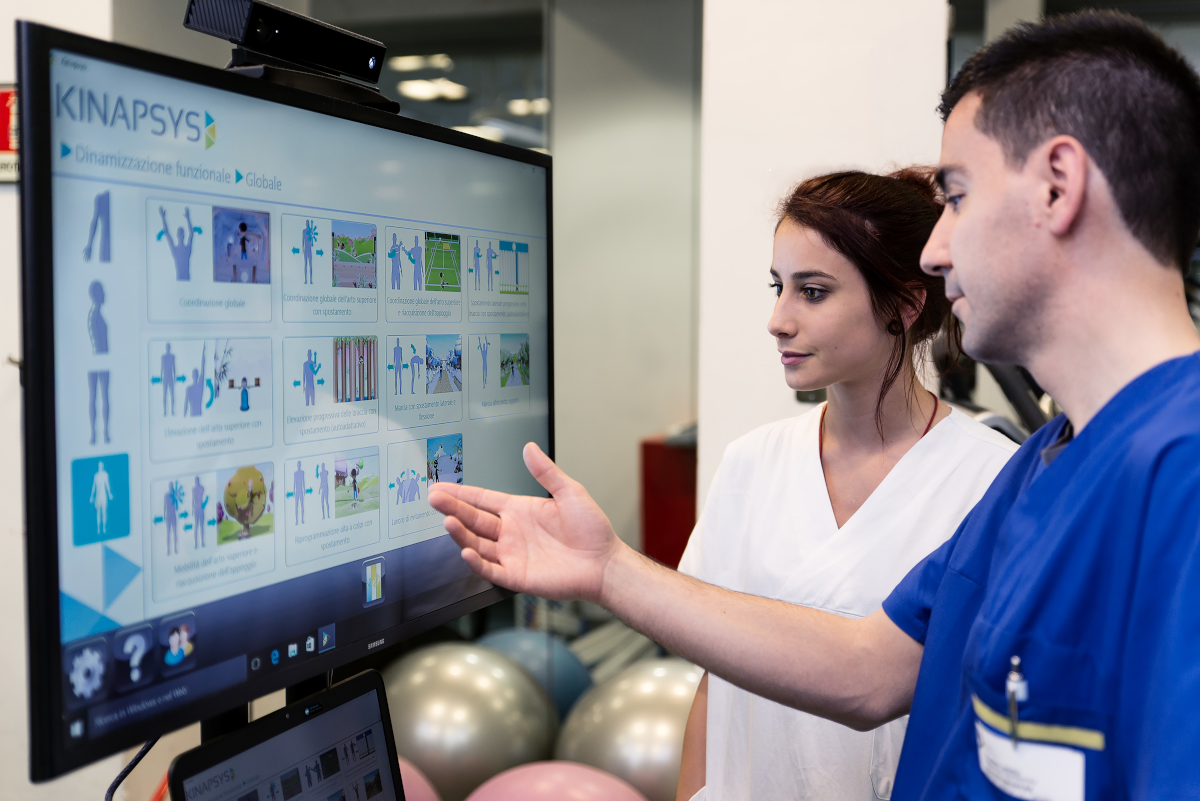
The second year is structured around 30 ECTS credits of placement in the IRCCS San Raffaele Hospital laboratories, alongside teaching directly linked to research activities: cognitive function analysis (with structural and functional imaging modules and instrumental clinical assessment), movement analysis (surface EMG, kinematic analysis, balance assessment systems) and advanced rehabilitation technologies (virtual reality, robotics, transcranial magnetic stimulation, functional electrostimulation). These are the tools students work with in the laboratories during their placement.
Laura Lumaca, a speech and language therapist, is researching primary progressive aphasias at the IRCCS, working with automatic transcription and machine learning. Andrea Grassi, a physiotherapist, is studying freezing of gait in Parkinson’s disease using fMRI and wearable sensors. Both graduated in Rehabilitation Sciences at UniSR and were hired within days of completing their degrees.
The programme is designed to be compatible with professional work: sessions concentrated into a few days a week, a proportion of ECTS deliverable remotely, and a compulsory attendance threshold of 67%.
Public or private: where the degree takes you
The SSN is the primary employer in the rehabilitation field, but it is not the only one. The accredited private sector (care homes, community rehabilitation centres, residential facilities) is in steady expansion, and here too coordination and clinical supervision roles require a master’s qualification by contract.
Those who choose the hospital route will find in IRCCS institutes and leading hospitals settings where the master’s is the minimum requirement for research and management access. Those who prefer accredited private providers will find organisations that are growing and actively seeking professionals capable of managing teams and designing care pathways.

Written by

UniSR Communication Team
Thanks to the contribution of the various team members, the UniSR Marketing and Communications Service deals with the multiple communication areas of the University: news scouting, creation of news, audio and video, event organization, website management and institutional social media, drafting and publication of newsletters, support for institutional relations. The Service interacts with all the main stakeholders (students, teachers, technical and administrative staff, research community, territory) in order to support and potential communication (internal and external) of the initiatives related to teaching, research and public engagement.
Visit the author's page