Doctoral researchers work in depth. Research advances through specialisation, and the value of a PhD project often lies in the ability to pursue a specific problem with consistency and determination. Transferable skills in a PhD — how to communicate with non-specialist audiences, coordinate with professionals from different backgrounds, manage data and projects, collaborate across disciplinary boundaries, develop organisational capabilities, learn to solve problems, understand the social context of research, and engage with a broader perspective — are built outside the research project itself. These skills matter and should not be overlooked, including for careers beyond academia. According to an analysis of the career paths of more than 2,000 researchers trained at EMBL, only 28% went on to hold a permanent academic position, the path most doctoral students prepare for.
These are essential, not optional, competencies for a doctoral researcher’s professional development. At Università Vita-Salute San Raffaele, they are already embedded in the PhD curriculum through dedicated courses on Open Science, Science Communication, Citizen Science, European research funding, Data Management, Research Integrity, Gender Equality, and Scientific Writing. These initiatives represent a concrete commitment to providing doctoral students with a broader formation.
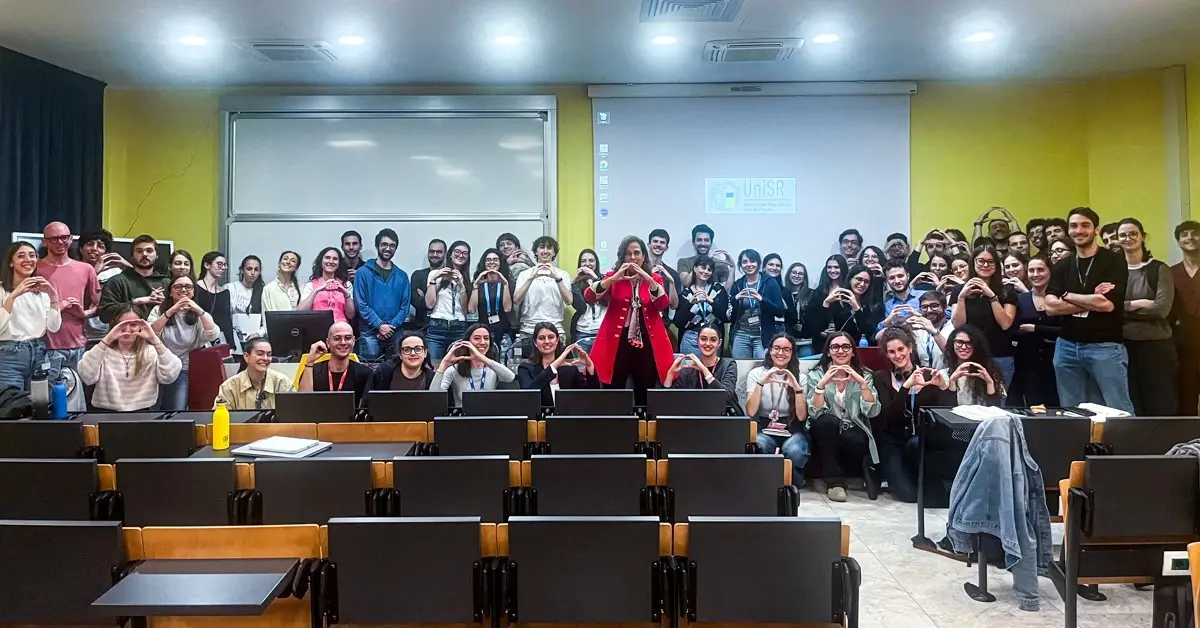
Alessandra Rocco is studying mitochondrial dysfunction in paediatric neurological disorders for the International PhD Programme in Molecular Medicine at UniSR. This year, together with the student committee, she organised one of the PhD Invited Lectures, an opportunity to bring a different perspective into the room. The guest was Ilaria Capua. It was worth it, and not only for the content of the lecture itself.
How a PhD Invited Lecture Comes Together
The student committee had a mandate: find speakers able to address a diverse doctoral audience on topics that went beyond their own specialisation, without sliding into the generic.
«We were looking for people who could speak to a broad audience» Dr Rocco explains, «offering a cross-disciplinary reflection on the role of science in contemporary society. Prof. Capua’s profile struck us as ideal: an internationally recognised scientist, able to connect research, public health, sustainability, and the social dimension».
Selecting the speaker was only part of the work. The student committee played an active role in liaising with the guest and in coordination. The organisation also proceeded in close collaboration with the PhD programme coordinator, Prof. Alessandra Bolino, and the PhD Office, whose support was essential for managing the organisational, institutional, and logistical aspects.
Prof. Ilaria Capua has moved across very different fields over the course of her career: from laboratory virology to the Circular Health framework, a model that rethinks the relationship between human, animal, plant, and environmental health as an interdependent system, and an evolution of the One Health paradigm. She works in public science communication and advocates for the role of women in STEM. «The fact that she has reinvented her path more than once without losing scientific rigour» Rocco says, «captures very well the idea of a scientist who has not confined herself to a single field».
Circular Health and Basic Research: How Far Apart Are They?
During the lecture, Prof. Capua presented Circular Health to an audience of doctoral students working, for the most part, on narrowly defined problems. Rocco is candid about that distance. «Circular Health still feels quite removed from the daily practice of research, at least for many of us doctoral students. It certainly does for me,» she says.
But that is precisely the point. «Lab work tends to focus attention on a very small slice of the scientific problem» Rocco observes. «Listening to a broader, interdisciplinary perspective was an invitation not to lose sight of the bigger picture. Prof. Capua reminded us how deeply interconnected health, environment, society, and technology already are. Reflecting on this will certainly shape the way I think about research and its impact».
What Organising a Scientific Event During a PhD Teaches You
Coordinating an event with an international guest is logistically demanding. It requires pitching an initiative to someone who does not know you, managing timelines and expectations, solving problems while the event is already under way, and working as a team. Recent literature highlights how the structured integration of transferable skills into doctoral programmes is growing, though it remains uneven across institutions.
International studies, including research published in Higher Education Research & Development in 2026 (Chen et al.), show that these skills significantly improve the employability of PhD graduates outside academia. Their development is also strongly supported by the European Union, as demonstrated by instruments such as ResearchComp, which promotes cross-sector mobility by strengthening researchers’ transferable skills.
UniSR has been active on this front for years, as a partner in the European project PATTERN, whose overarching objective is to promote inclusive and sustainable practices in Open Science and Responsible Research and Innovation, through the development of dedicated training programmes for researchers across eight core transferable skills.
«Organising an event means having the chance to interact directly with people at the highest level, to hear their journey up close, and to understand the human side that so rarely comes through in scientific papers», Rocco recounts. In that kind of direct encounter with prominent figures, something beyond skills sometimes surfaces: «In Prof. Capua’s case, I was genuinely struck by her generosity and warmth. She is extremely direct and efficient, but at the same time very open to dialogue with students. Being part of that kind of exchange in person was truly motivating».
Cross-Disciplinary Seminars: a Broader Ecosystem
The PhD Invited Lecture with Prof. Capua is not an isolated event, but part of a wider ecosystem of cross-disciplinary activities promoted within the doctoral programme. On 21 May, for example, the seminar “Filters and Reality. Self-image across body, mind, and the digital gaze” was held. An interdisciplinary event designed by doctoral students for doctoral students, on the theme of self-representation in the age of social media.
The event brought together different perspectives:
- Marco Bernardi, psychologist at Fondazione Carolina;
- Martino Guiotto, plastic surgeon at the Regional Hospital of Lugano;
- Guido Nosari De Danieli, artist.
The group offered an integrated view across psychological, clinical, and visual dimensions. Topics included identity, aesthetic pressure, digital visibility, cyberbullying, and vulnerability, with particular attention to their impact in academic communities and among younger people. Initiatives of this kind show how at UniSR doctoral students are not only recipients but can become active promoters of interdisciplinary learning moments.
Why It Is Worth Developing Transferable Skills
For next academic year, Alessandra Rocco would like to do it again. «If someone asked me why it is worth it, I would say that an experience like this enriches you enormously, both professionally and personally». Transferable skills in a PhD are built through a combination of structured training, institutional initiatives, and the active participation of doctoral students.
Bibliography
Meta-Research: The changing career paths of PhDs and postdocs trained at EMBL, Lu et al., 2023, eLife
PhD employability beyond academia: an analysis of industry skills emphasis through a cultural capital lens, Chen et al., 2026, Higher Education Research & Development, 45(1), 81–99
Promuovere la ricerca e l’innovazione aperta e responsabile: un anno del progetto europeo PATTERN, 2024, https://www.unisr.it/news/2024/1/1-promuovere-la-ricerca-e-innovazione-progetto-europeo-pattern
PATTERN project website: https://www.pattern-openresearch.eu/
ResearchComp: The European Competence Framework for Researchers, https://research-and-innovation.ec.europa.eu/jobs-research/researchcomp-european-competence-framework-researchers_en