30 Jun, 2026
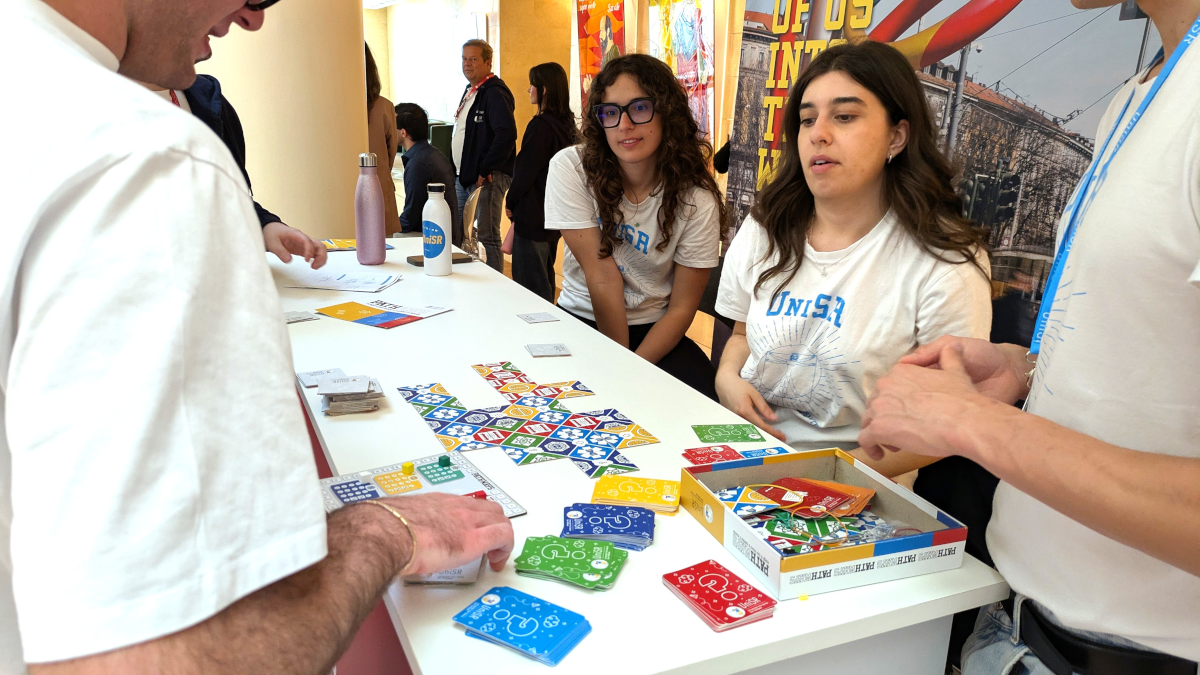
Pathways is the board game on university orientation designed by Vita-Salute San Raffaele University together with Tambù, a company specialising in gamification and game design. Sixty-four tiles, five subject areas, general knowledge questions and scenarios drawn from real university life. No ready-made answers about what is best to study: the aim is to create a space in which young people can test themselves in reasoning, in putting decision-making processes into practice, and in engaging with others.
Why a Game for University Orientation?
An open day is an essential tool for getting to know degree programmes, lecturers and facilities up close, and for clarifying specific questions about different courses of study. Pathways occupies a different space: it works at an earlier stage, where the questions are less about "which course to choose" and more about how to choose.
"Pathways — Choose Your Future and Change the World" is a cooperative game that leads a group to build a path together, answer subject-area questions and confront scenarios from real university life. Education is not only the transmission of knowledge, but a journey of personal growth. What matters is not only "what to choose" but how to learn to choose: by listening to ourselves, engaging with others, and recognising both our inclinations and the opportunities the world offers us.
How Pathways Works
The kit contains 64 square tiles, each carrying symbols on all four sides. The symbols represent five areas of knowledge aligned with the main academic fields at UniSR: Psychology; Political, Legal and Economic Sciences; Humanities and Philosophy; STEM subjects; and Medical Sciences.
Players take turns drawing and placing tiles, trying to connect matching symbols: the longer and more consistent the chain, the more points are scored.
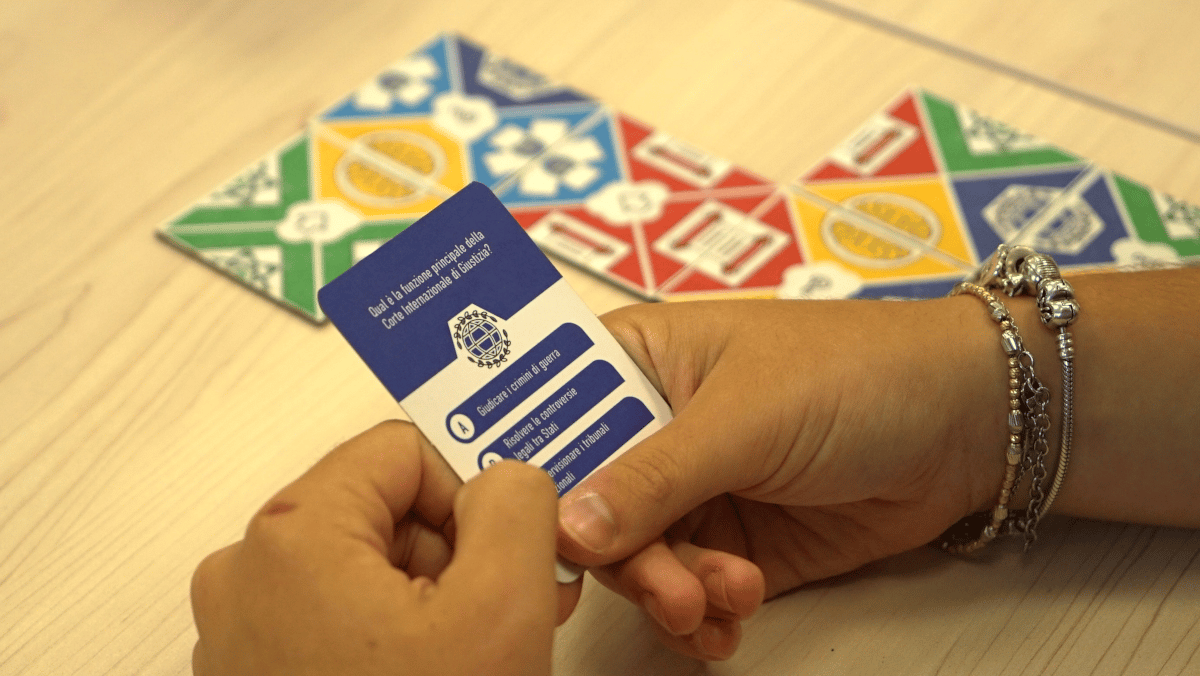
Alongside the standard tiles are special tiles, which allow players to accumulate advantages or access the quiz cards for the different subject areas. For each correct answer, the tile is placed and a new one drawn immediately.
The quiz decks do not only test prior knowledge. Every card also includes an explanation of the correct answer, because the game has an explicitly educational function: each question becomes an opportunity to broaden the group's general knowledge, stimulate curiosity and open discussion, regardless of the outcome.
Degrees: the Progression System
When eight complete symbols of the same type accumulate along the path, the team earns a Degree in that subject area and advances five spaces on the board. At twelve symbols of the same type, a Master's degree is achieved, with a further advance of ten spaces.
Each Degree unlocks a Situation card: the most distinctive mechanic in the game from an orientation perspective.
Situation Cards: When the Game Becomes a Mirror
The eighteen Situation cards present scenarios from university and community life, each with three possible responses: one is deliberately less effective, the other two are ambiguous by design. There is no single correct answer.
The scenarios are built around concrete situations: a group member who does not respect deadlines, a friend undecided about whether to go on Erasmus, a degree choice that seems difficult to make. Each response generates an effect on the score and, when the game is played across multiple tables, on the neighbouring teams as well.
The aim is not to find "the correct answer" but to practise reasoning together and considering different points of view. This is where group dynamics emerge: who takes the initiative, who listens, who decides quickly, who prefers to mediate.
The Debrief: Where the Game Meets University Orientation
The game ends when the last face-down tile is drawn and placed. The points tally closes the game, but it is the debrief that turns it into an orientation tool.
Facilitators are offered a series of guiding questions to calibrate to the group: How did you make decisions? Was there disagreement? How did you handle it? Which strategy proved most useful? If you played again, what would you change? These are not questions about university in the strict sense: they are questions about the method by which we reason, and they open players' eyes so they can move closer to the answers they are looking for.
Pathways in Schools: How to Use It in the Classroom
The game is designed for groups of five to six participants. With a single group, the facilitator leads the session and the debrief. With several tables running simultaneously, each group elects its own moderator, and this choice too becomes material for observation.
During play, facilitators move between the tables, intervening only to clarify the rules and observing the dynamics. The accompanying teacher can collect useful material to continue the reflection in class afterwards.
The five subject areas of Pathways correspond to the main fields of university study. The game works both as a standalone orientation tool and as an integrative activity within structured programmes.
Discover UniSR at Our Open Days
Pathways is a project of Vita-Salute San Raffaele University, an institution that unites health sciences, psychology and philosophy within a campus integrated with San Raffaele Hospital. The same five subject areas of the game — from Psychology to Humanities and Philosophy, from Medical Sciences to STEM through to Political, Legal and Economic Sciences — reflect the conviction that knowledge grows when fields meet. If Pathways has brought an interest, an inclination, or even just a more precise question to the surface, the open days are the opportunity to explore it further: meeting lecturers and students from the different degree programmes, understanding how studying at UniSR really works and what concretely distinguishes one path from another.
Written by

UniSR Communication Team
Thanks to the contribution of the various team members, the UniSR Marketing and Communications Service deals with the multiple communication areas of the University: news scouting, creation of news, audio and video, event organization, website management and institutional social media, drafting and publication of newsletters, support for institutional relations. The Service interacts with all the main stakeholders (students, teachers, technical and administrative staff, research community, territory) in order to support and potential communication (internal and external) of the initiatives related to teaching, research and public engagement.
Visit the author's page