14 May, 2026
Although peripheral nerves can regenerate after injury, recovery is often poor in the elderly, in people with conditions such as diabetes, or after particularly severe trauma. The vascular system actively supports nerve repair by shaping the healing environment and protecting neural tissue through the blood-nerve barrier (BNB). This specialised neurovascular structure is formed by blood vessels that runs alongside axonal fibres within peripheral nerves, shielding them from mechanical stress, toxic substances and harmful agents. Disruption of the BNB is now increasingly recognized as a key contributor to pain and neuropathy.
Unlike its better-known counterpart, the blood-brain barrier (BBB), which protects neurons and glial cells in the brain and spinal cord, the BNB has been historically understudied, because peripheral blood vessels are few and poorly accessible with standard techniques.
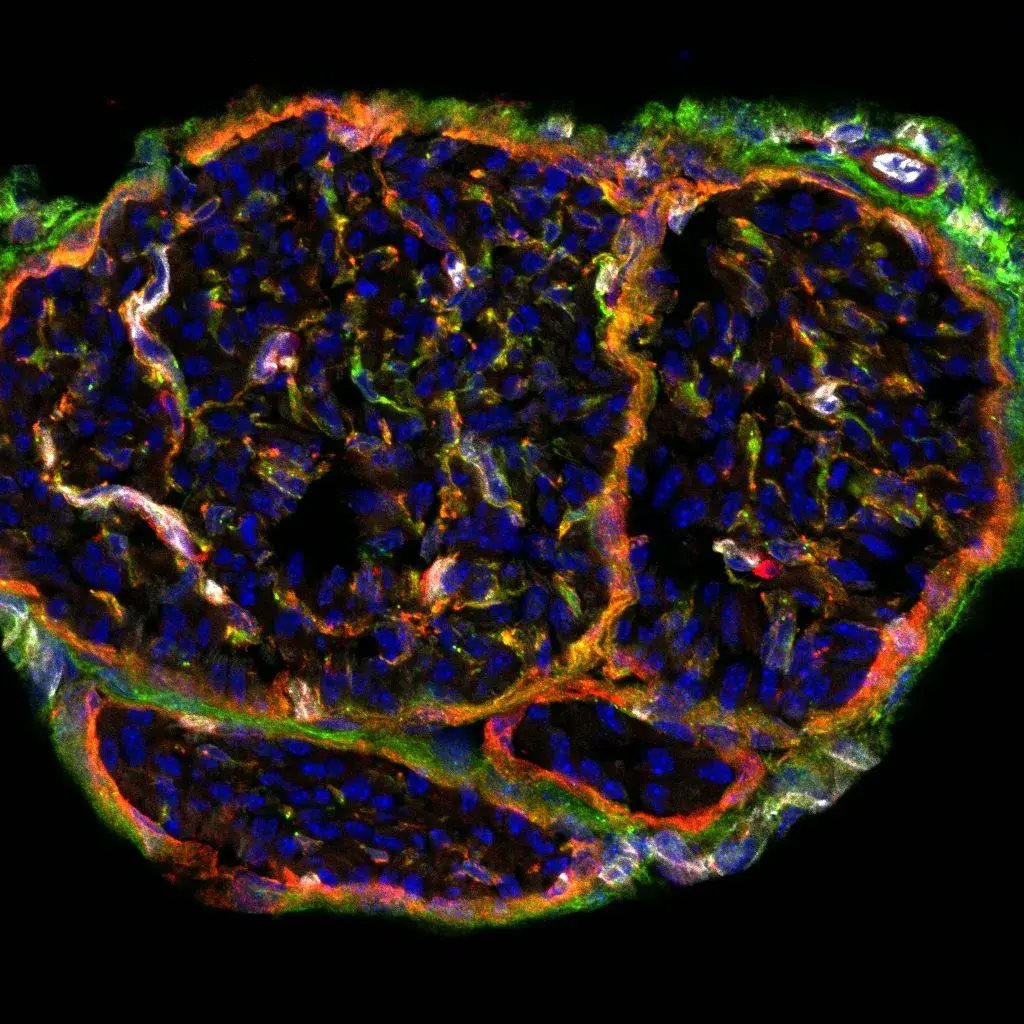
Transverse section of sciatic nerve showing capillaries forming the blood-nerve-barrier (grey) and stromal cells stained for NG2 (red) and PDGFRa (green). Nuclei are in blue. Credits: Dr. Dario Bonanomi
What is the blood-nerve barrier and why does it matter
«We don’t know much about the cellular composition and molecular properties of the BNB. Moreover, we don’t fully understand its function in nerve regeneration upon injury, a process that typically occurs in the peripheral, but not the central nervous system. We believe that the BNB can act as a hub of chemical and mechanical signaling central to nerve regeneration», says Dr. Dario Bonanomi.
Heading the Molecular Neurobiology lab at IRCCS San Raffaele Hospital in Milan, Dr Bonanomi recently received the ERC Synergy Grant together with the research groups of Isabelle Brunet (Inserm, France), Tambet Teesalu (University of Tartu, Estonia) and Ellie Tzima (University of Oxford, UK).
Their aim? Joining forces to address the many unknowns about the BNB and study its involvement in peripheral nerve regeneration and neuropathic pain induced by chemotherapy drugs, a major unmet medical need.
How the blood-nerve barrier drives peripheral nerve regeneration
In previous studies, Dr. Bonanomi and his team showed that blood vessels in peripheral nerves are essential to the regeneration process.
«Upon nerve injury, vessels form polarized scaffolds that help axon regrowth. When you destroy vessel polarization, regeneration is impaired», explains Bonanomi.
«When peripheral nerves in adult organisms are injured, vessels turn on a developmental program that is necessary for nerve regeneration. Specifically, the endothelium upregulates the Plexin-D1 receptor that guides axonal migration in the regenerating nerve. If you remove Plexin-D1 from the vessels of the injured nerve in the adult, the vasculature becomes disorganized and cannot provide the necessary tracks for guided nerve regeneration», says Bonanomi.
But vessels are more than tracks along which axons and Schwann cells migrate to cross the lesion site: they are also hubs for molecular cues that orchestrate tissue repair.
The team has shown that blood vessels growing into a wound help shape the surrounding tissue, instructing fibroblast-like cells to form protective “tunnels” through which regenerating axons extend.
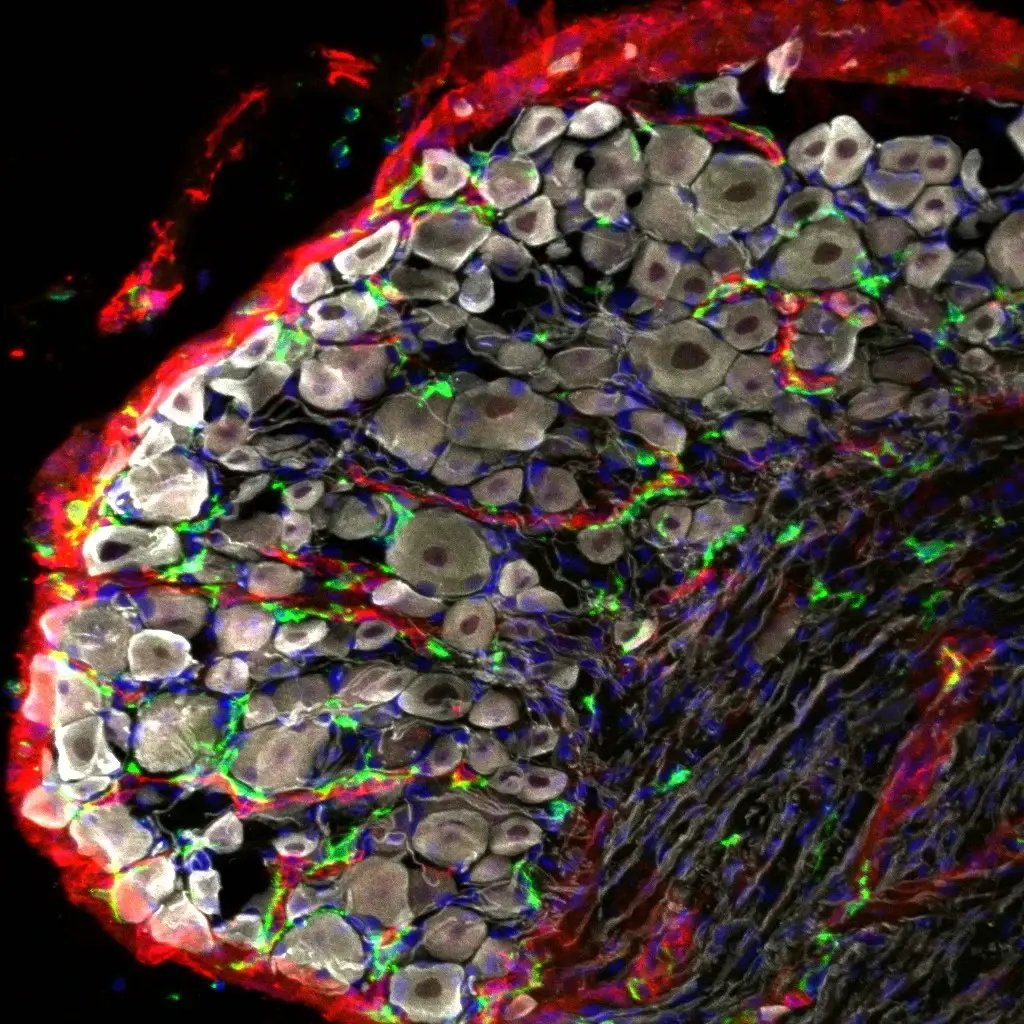
Sensory ganglion labeled to visualize neurons (grey), blood vessels (red) and macrophages (green). Nuclei are in blue. Credits: Dr. Dario Bonanomi
MINerVA: four labs, one ERC Synergy Grant, three open questions
These insights converged into a large, collaborative effort: the MINerVA project supported by the ERC Synergy Grant.
The project brings together complementary expertise from four labs in neurovascular signaling, in vivo peptide homing, and endothelial mechanotransduction to address the following questions:
1. How is the BNB organized?
2. How does it respond to injury?
3. How does BNB dysfunction contribute to disease?
Single-cell and spatial transcriptomics now enable researchers to study cell composition down to molecular precision.
«Thus, we plan to use such techniques in my lab to know the identity of the cells interacting with the endothelium in the BNB», clarifies Dr. Bonanomi.
The team also aims to map the molecular profile of peripheral blood vessels using homing peptides, a technology developed by Dr. Tambet Teesalu’s lab in Estonia.
«In this context, homing peptides will serve a double function: on one hand, as tools that can bind the set of receptors decorating the vessels, thus helping to map their molecular diversity. On the other hand, since these peptides are designed to cross the BNB, they can also be used as shuttles to selectively deliver drugs through the BNB and reach specific targets in the nerve for therapeutic purposes», explains Dr. Bonanomi.
Mechanical forces and the blood-nerve barrier: a new research frontier
Peripheral nerves run through our skin and muscles and are therefore continuously stretched and twisted as we move. How, then, do they preserve their integrity, and particularly that of the BNB, under such mechanical stress, and how does this strain affect peripheral nerve function and regeneration?
With the contribution of Dr. Ellie Tzima, an expert in endothelial mechanobiology, the MINerVA team will identify new mechanoreceptors operating at the BNB using a combination of cellular assays, biochemical approaches, and novel mouse genetic models that uncouple the chemical and mechanical signaling activities of these receptors.
Understanding how BNB cells sense and interpret mechanical signals is where basic and translational research converge.
Building on insights from Isabelle Brunet’s lab, the team will explore the possibility that chemotherapy-induced peripheral neuropathy (CIPN), which affects approximately 90% of patients receiving platinum-based drugs, may partly arise from vascular constriction within the nerve, a mechanical stressor that abnormally activates sensory fibers and triggers pain.
«This is where homing peptides could come into play as shuttles: we hope to leverage their capacity to cross the BNB to selectively deliver drugs that correct nerve endothelial mechanosensitivity and, potentially, alleviate neuropathic pain», concludes Dr. Bonanomi.
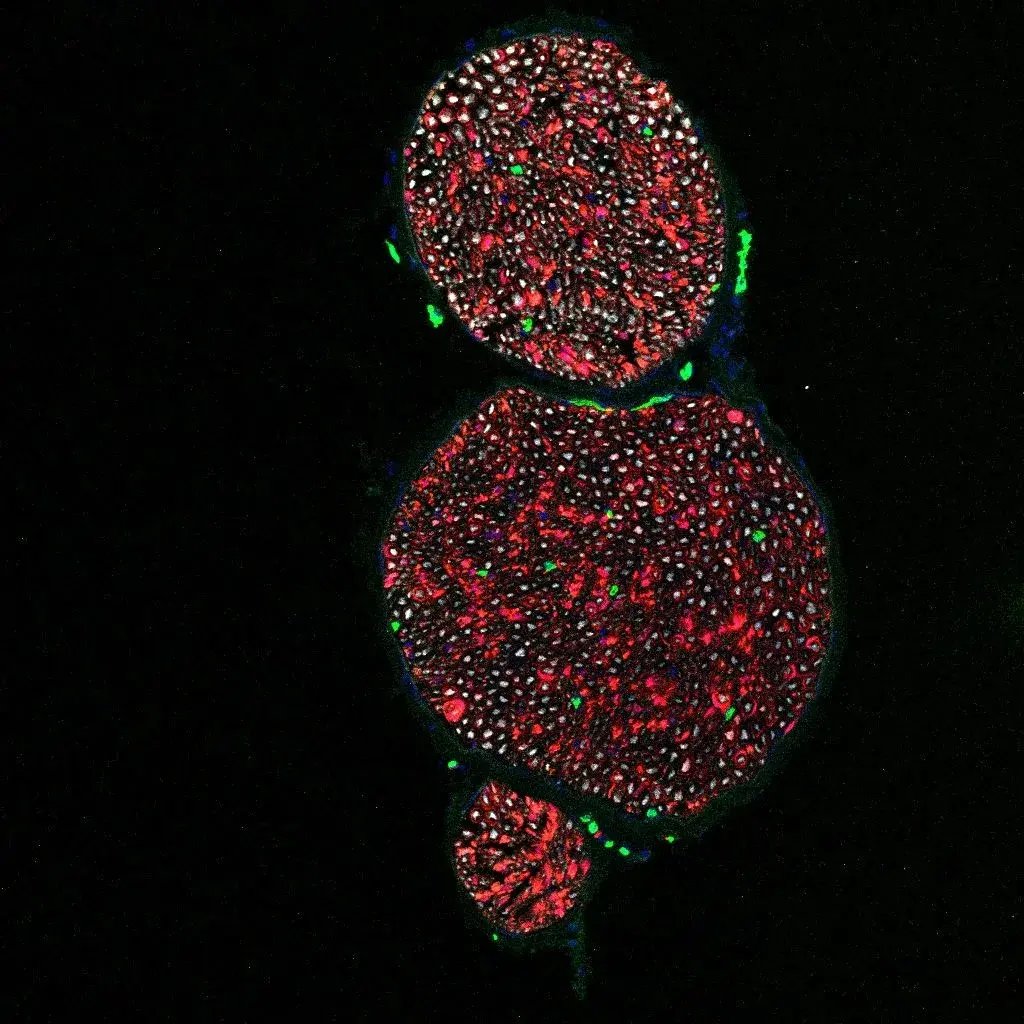
Transverse section of peripheral nerves showing capillaries (green) that establish the blood-nerve-barrier nearby axons (grey) and associated Schwann cells (red). Credits: Dr. Dario Bonanomi
FAQ on the blood-nerve barrier
What is the blood-nerve barrier?
The blood-nerve barrier is a specialised neurovascular structure found inside peripheral nerves. It is formed by blood vessels that run alongside axonal fibres, creating a selective barrier that shields the nerve tissue from mechanical stress, toxic substances, and harmful agents circulating in the bloodstream. Its function is broadly analogous to that of the blood-brain barrier in the central nervous system, but it operates in a very different anatomical environment.
Why has the blood-nerve barrier been so difficult to study?
Unlike the brain, where blood vessels are dense and relatively accessible, peripheral nerves contain few blood vessels that are hard to isolate and analyse with standard laboratory techniques. This has limited researchers' ability to characterise the cellular composition and molecular properties of the BNB, leaving fundamental questions about its role in nerve repair and disease largely unanswered.
What happens to the blood-nerve barrier after nerve injury?
After peripheral nerve injury, the blood vessels within the nerve activate a developmental programme that supports regeneration. They form polarised scaffolds that guide axon regrowth and release molecular signals that instruct surrounding cells to build protective tunnels through which regenerating axons can extend. When this vascular response is disrupted, nerve regeneration is significantly impaired.
Written by

UniSR Communication Team
Thanks to the contribution of the various team members, the UniSR Marketing and Communications Service deals with the multiple communication areas of the University: news scouting, creation of news, audio and video, event organization, website management and institutional social media, drafting and publication of newsletters, support for institutional relations. The Service interacts with all the main stakeholders (students, teachers, technical and administrative staff, research community, territory) in order to support and potential communication (internal and external) of the initiatives related to teaching, research and public engagement.
Visit the author's page