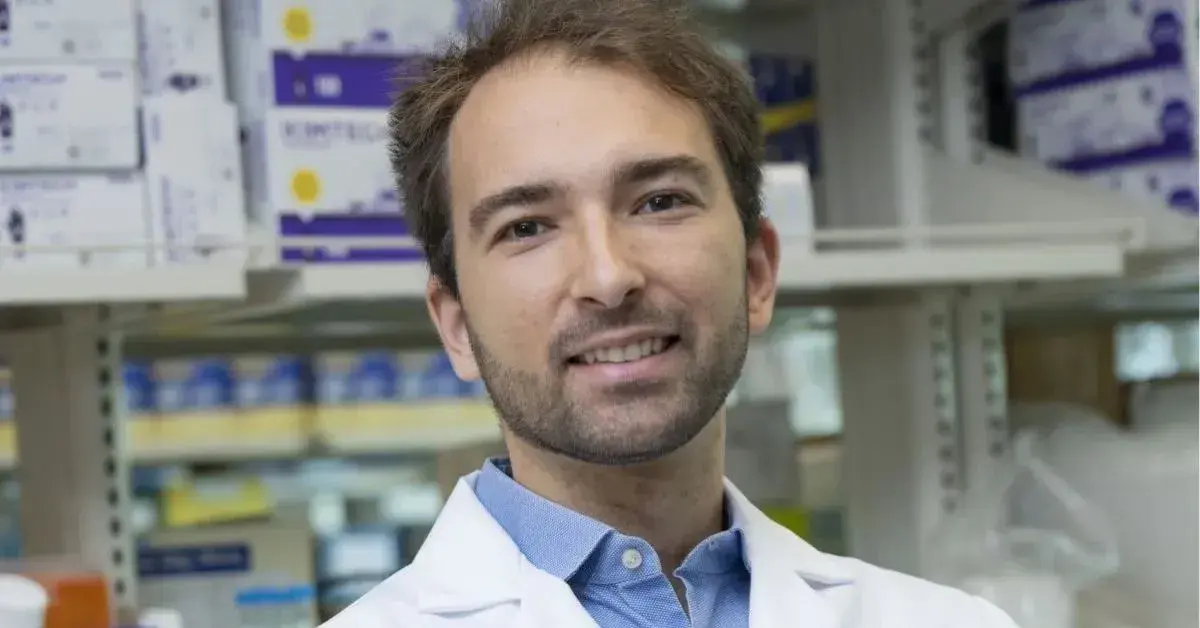
In the United States and several European regions, colorectal cancer incidence among adults under 50 has been rising steadily. This age group was long considered low-risk, yet it now accounts for roughly 10–15% of new diagnoses, and the underlying causes remain largely unknown. «In Italy, this increase has not yet spread nationally, though we are observing a trend right here in Milan, the most internationally connected city in the country. Early diagnosis, ideally before symptoms appear, is essential to intervene promptly and prevent the disease from reaching an advanced stage,» says Dr Alessandro Mannucci, a UniSR alumnus and clinician at San Raffaele Hospital, Milan (IRCCS). Mannucci is first author of a multicentre clinical study published in Gastroenterology, describing a new blood test for the early detection of colorectal cancer in younger patients.
How the test works: cell-free and exosomal micro-RNAs
The method developed by Mannucci and his colleagues exploits circulating micro-RNAs in the blood as early tumour biomarkers. Its defining feature is the simultaneous analysis of two complementary components: cell-free micro-RNAs and micro-RNAs carried inside exosomes, microscopic vesicles released by tumour cells that carry a molecular fingerprint of the tumour itself.
Cell-free micro-RNAs are abundant in circulation and offer high sensitivity, but limited tumour specificity: they originate from multiple cell types. Exosomal micro-RNAs, by contrast, provide a far more specific signal, the exosomes that carry them more faithfully reflect the characteristics of the tumour cells that produced them. In practical terms: the first component captures the signal even when it is faint; the second traces it back precisely to its tumour source. The test combines both to preserve each advantage.
«In the first phase of the study, we profiled blood samples from patients with early-stage colorectal cancer to identify the cell-free and exosomal micro-RNAs most strongly associated with the tumour,» Mannucci explains. «We then trained a machine learning algorithm combining both components and validated it on new blood samples, obtaining highly accurate and specific results. The test integrates sensitivity and specificity.»
The method is still experimental and will require further validation at larger scale.
Why micro-RNAs are better biomarkers in younger patients
Several liquid biopsy tests for colorectal cancer already exist. They work by detecting methylation alterations in circulating tumour DNA, abnormalities in the distribution of methyl groups (–CH₃) across the tumour-derived genome. These tests are currently approved only in the United States, and only as a screening tool for adults aged 45 and over. «DNA methylation is an age-dependent signal that tends to be more pronounced in older individuals. In younger patients it can be weaker, and therefore less effective as a biomarker» Mannucci says.
Micro-RNA analysis takes a different approach. Across the age spectrum, the study found elevated and stable micro-RNA levels between the ages of 20 and 50 in patients with colorectal cancer. In individuals who do not develop the disease, micro-RNA values remain consistently below the diagnostic threshold. These biomarkers provide a robust signal regardless of age, making them well suited as a screening tool in younger adults.
An unexpected finding: post-surgical monitoring
One result in particular surprised the research team. Analysing paired pre- and post-surgical samples from a subset of patients, the researchers expected biomarker levels to decline gradually after tumour removal. Instead, by day four post-surgery, levels had already fallen below the diagnostic threshold — the test had turned completely negative.
In the literature on minimal residual disease in colorectal cancer, meaning the minimum tumour signal detectable in the body after treatment, this kind of clearance is typically documented weeks after surgery, not days. «Four days is an unexpected result, and it opens a new avenue. The same liquid biopsy test could be used not only for early diagnosis, but also for monitoring after treatment, a particularly relevant application for young patients, who have decades of life and follow-up ahead of them,» Mannucci adds.
From UniSR to Harvard and Los Angeles: Mannucci’s career path
Alessandro Mannucci completed his entire medical training at Vita-Salute San Raffaele University: first the International Medical Doctor Program, then a residency in Diseases of the Digestive System. He began his research trajectory alongside Professor Giulia Martina Cavestro, founder and director of the clinical and research project "Gastro Per Me", aimed at patients with juvenile tumors and hereditary oncological syndromes, halfway through his third year of medicine, a scientific collaboration that has now spanned more than a decade.
A dissertation at Harvard Medical School
Towards the end of his degree, the close working relationships with faculty that characterise UniSR gave Mannucci access to the Dana-Farber Cancer Institute, a Harvard Medical School-affiliated oncology hospital, where he joined the laboratory of Professor Sapna Syngal to work on genetic predispositions to colorectal and endometrial cancers. The experience convinced him that research could become a structural part of his career, not merely an adjunct to clinical practice. The work was subsequently published in the Journal of Clinical Oncology, one of the leading oncology journals worldwide.
After several years of predominantly clinical work during his residency, Mannucci decided to invest time in developing laboratory skills, a deliberate step that meant starting again in a learner’s position. He moved to Los Angeles, to City of Hope, where he worked in the laboratory of Professor Ajay Goel, a specialist in biomarkers and translational research in gastrointestinal oncology.
Part of the analysis for the Gastroenterology study was conducted during his time in Los Angeles. Today Mannucci works at San Raffaele Hospital, where since January 2026 he has been coordinating a project funded by an AIRC Startup Grant (Italian Association for Cancer Research). The project applies the same high-sensitivity, high-specificity, machine learning-based approach to pancreatic cancer in individuals with genetic predisposition or pre-neoplastic lesions.
Three lessons from a decade in research
From Mannucci’s experience, three observations stand out for those starting out in academic medicine.
Dream ambitiously — even recklessly. The biggest ambitions are also the most daunting ones. «It was not easy to start doing research after years of clinical practice, but I wanted to follow that path, to put myself on the line, accepting from the outset that things might not go as planned,» he recalls.
Build resilience for rejection. Negative responses, from paper reviewers, grant panels, potential collaborators, are intrinsic to the scientific process. Each one, Mannucci argues, teaches you to write more clearly, to communicate your research more effectively, to make scientific thinking accessible to those outside your specific field.
Protect your mental balance. Carrying significant responsibility in both clinical and research settings means sustained pressure. «Over time I have learnt that a certain level of pressure is unavoidable, and not always negative. But you always need to find equilibrium, to carve out personal space. That is the necessary foundation for ambition, and for staying curious and creative over the long term,» he concludes.