5 Nov, 2026
Robotic prostate surgery has made the operation for the most common cancer in men in Europe more precise and less invasive. Patients return to daily life sooner, and the impact on continence and sexual function is smaller.
Italy records about 40,000 new diagnoses a year, and the five-year survival rate is 91%. These estimates come from AIOM and AIRTUM, the Italian associations of medical oncologists and cancer registries. Alberto Briganti, Full Professor of Urology at Vita-Salute San Raffaele University, describes what has changed in the operating theatre and when men should see a urologist.
Robotic prostate surgery: why surgeons use a robot
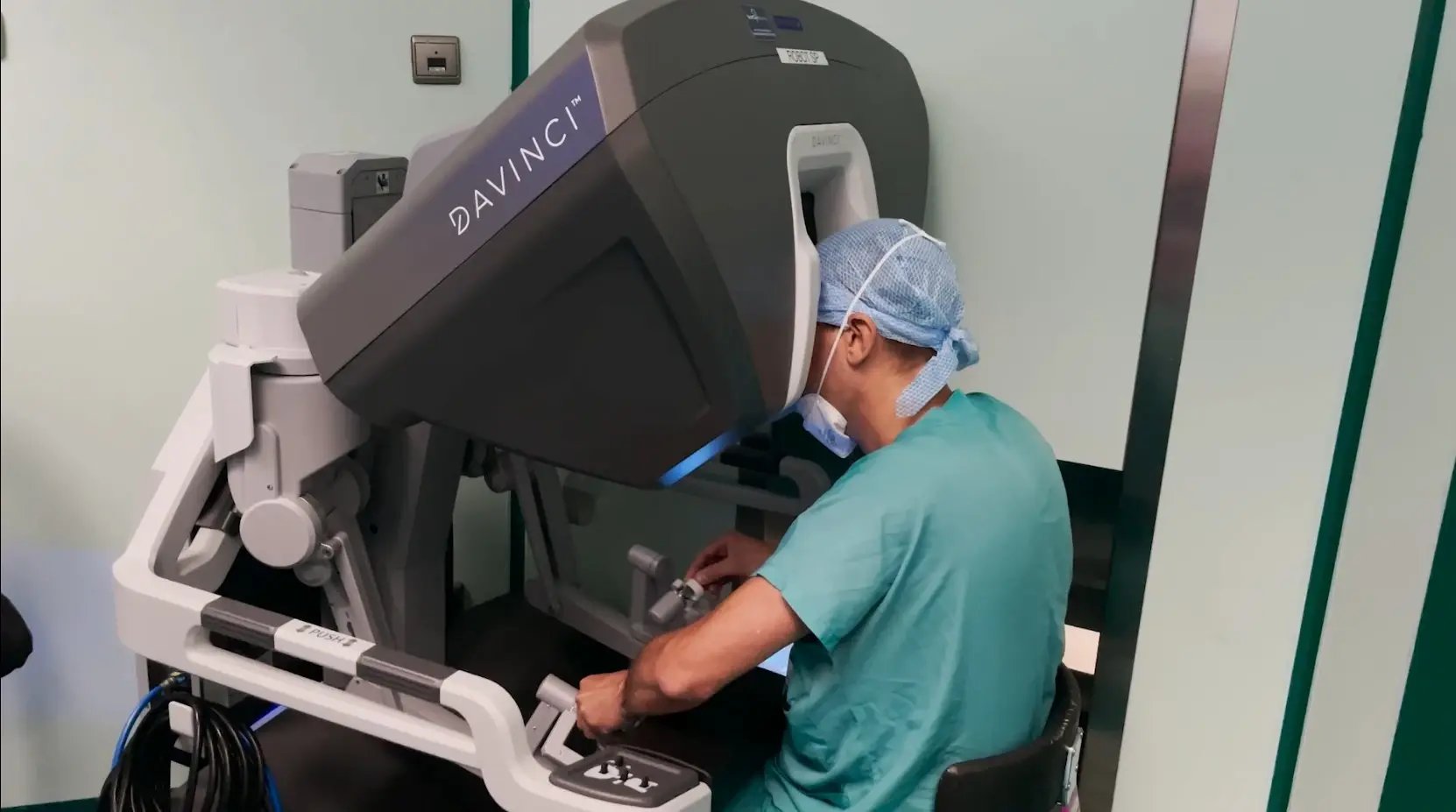
The prostate is a walnut-sized gland in the male reproductive system, just below the bladder. It surrounds the first part of the urethra and produces part of the seminal fluid. The gland sits in the pelvis, a very tight space deep inside the body. This makes it hard to reach, especially in patients with a narrow pelvis or obesity. The robot lets the surgeon work from very close up. The view is magnified and three-dimensional, and the instruments have many degrees of freedom: they move like a human wrist.
These are the main reasons why surgeons have adopted the robot for radical prostatectomy, the surgical removal of the prostate. It was one of the first operations to bring robots into the operating theatre, and today robotic prostate surgery is the main surgical approach.
Another technical factor plays a part. The operation uses pneumoperitoneum: surgeons pump gas into the abdomen to open up the space and reduce bleeding. Before robots, prostatectomy meant heavy blood loss and a slower recovery. «Today transfusion rates are close to zero. The robotic technique offers optical magnification and puts less surgical stress on the patient, so we can perform a more refined operation. For patients, this means getting back to everyday activities sooner», says Briganti. He directs the Robotic Surgical Programme and the Prostate Cancer Research Programme at IRCCS San Raffaele Hospital.
Continence and erectile function after robotic prostatectomy
Recovery of bodily functions after a robotic prostatectomy is what worries patients most. More than 80% of men who have robotic prostate surgery regain urinary continence within three months of the operation.
Erectile function is harder to assess, because it depends largely on the patient’s condition before surgery. Among patients in very good condition beforehand, about 30–40% recover it early, within six months. These data come from large specialist centres such as IRCCS San Raffaele Hospital. Others need more time, but recovery is possible, especially with rehabilitation therapies that improve long-term functional recovery. With traditional open surgery, now almost abandoned, recovery took much longer.
Single-port robotic prostate surgery: one small incision
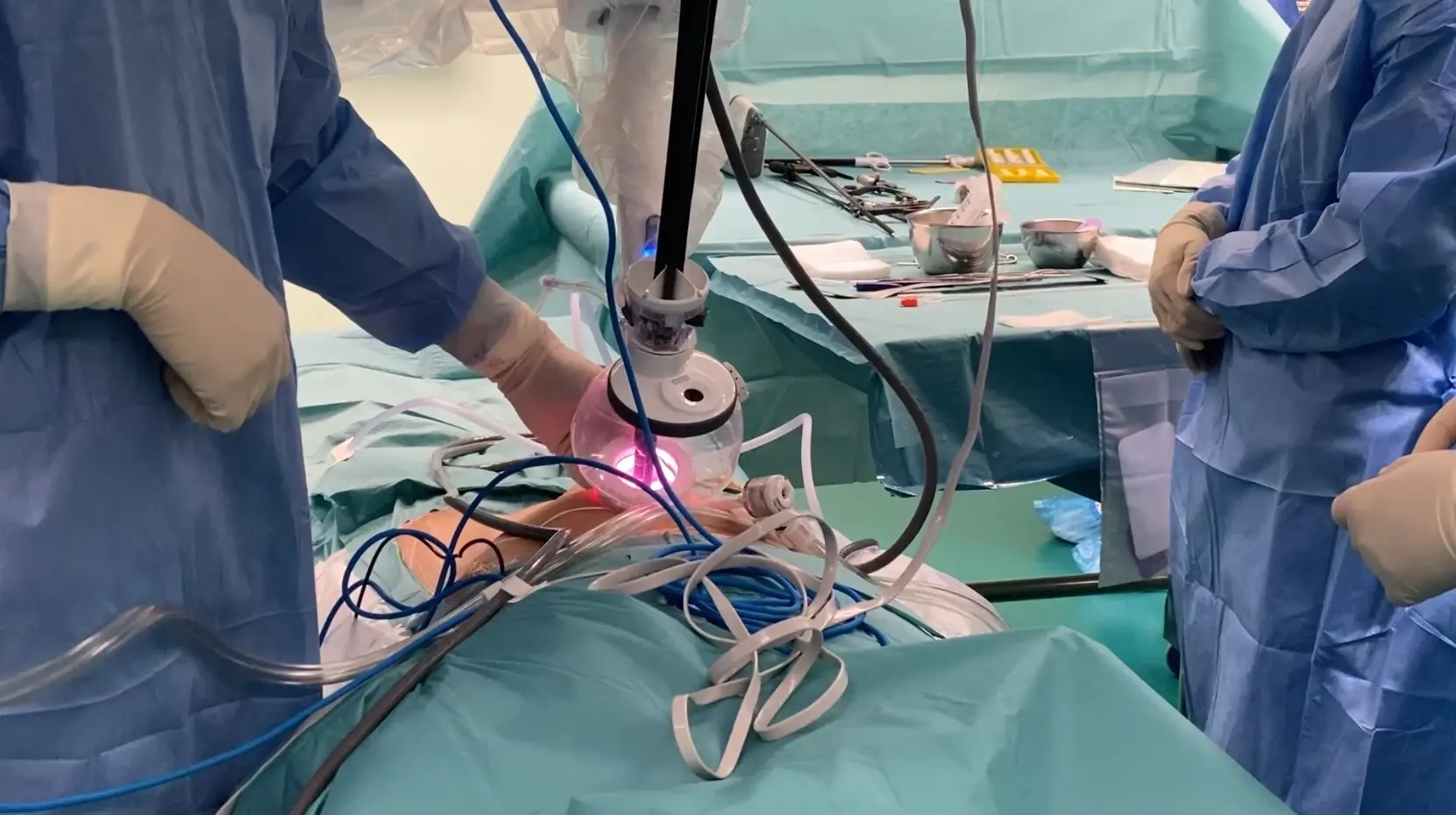
The single-port robot, the latest development, works through one small incision instead of the six or so needed in the past. Three operating arms and the camera come out of this single opening. Surgeons can add an extra port for the assistant at the operating table. The single incision is a significant advantage.
«Thanks to further miniaturisation, the single-port robot can fit into even smaller spaces. It needs less gas to open the surgical field, and some areas can be reached with less trauma to the tissues, so the impact on the patient drops even further», Briganti explains. The system relies on new technology for articulating the arms, so several instruments can move through one opening.
Artificial intelligence and prostate cancer: more accurate diagnosis
In prostate cancer, the main benefit of AI in medical diagnosis is better-quality tests. In magnetic resonance imaging (MRI), AI helps standardise how images are taken and reported. In biopsy, it helps doctors guide the needle more precisely towards the suspicious areas found on scans. PET images become more uniform and easier to interpret consistently. Another use is reading tissue samples on histology slides.
«All this makes it easier for us to diagnose disease, and it makes reports more reproducible», Briganti notes. «AI is also entering the operating theatre: 3D reconstruction models and image acquisition software help outline the tumour more clearly. In the future, we want to perform operations that preserve the anatomical structures even better».
A nomogram to decide on lymph node removal
Over the years, Briganti’s team has developed and refined several nomograms, predictive tools that calculate an individual patient’s risk. One of them estimates the probability that a patient with prostate cancer has lymph node metastases. The lymph nodes are one of the places where the disease can spread.
The calculation combines the clinical features of each patient’s disease with MRI and PET data. The result helps doctors plan surgery. It shows which patients need their lymph nodes removed and which patients can avoid the procedure because their risk of lymph node metastases is very low.
Early detection of prostate cancer: when to see a urologist
Early diagnosis of prostate cancer finds the disease in its initial stages, while it is still localised and less aggressive. In these cases, treatment can be an even less invasive and more precise robotic procedure that leaves the organ in place.
«Today the biggest challenge is cultural, and it concerns the whole population: people still see prostate cancer as a problem of old age, and so as something to check for later in life. The risk does grow with age, but it is important to assess a man’s long-term risk of developing the disease from a younger age», the professor observes. According to AIRC, the Italian cancer research foundation, the risk is low before 40 and rises after 50. The same data show that about two in three cases are diagnosed after 65. The Lancet Commission on prostate cancer estimates that, as the population ages, cases worldwide will rise from 1.4 million to 2.9 million a year by 2040.
«Attention to men’s health, and to the prostate in particular, should not suddenly start at 70, but at 40 at the latest», Briganti stresses. The aim is a model similar to the one women have long followed with regular visits to their gynaecologist. Men need regular check-ups with a urologist from their forties, even when they feel well. They also need tests that help predict the risk of future problems, in particular blood tests, including PSA (prostate-specific antigen) measurement.
What guidelines and screening programmes recommend today
The European Association of Urology (EAU) guidelines recommend offering the PSA test to men from the age of 50, after a discussion of the benefits and risks. The age drops to 45 for men of African descent or with a family history of prostate cancer, and to 40 for carriers of a BRCA2 gene mutation. The same guidelines suggest a strategy based on the first PSA result: men with a PSA above 1 ng/mL at 40 should repeat the test every two years.
In 2022, the Council of the European Union recommended that member states gradually evaluate organised PSA-based programmes, with MRI as a second-level test. In Italy, the Lombardy Region, for example, has already launched a programme of this kind.
Robotic prostate surgery has made the operation more precise and recovery faster, and it gives the best results when the disease is diagnosed early. For this reason, men over 40 should book an appointment with a urologist and ask the specialist which tests to have and how often to repeat them. For men, the urologist can become a key point of reference and a guide towards the right check-ups, just as the gynaecologist is for women.

References
- AIOM-AIRTUM, I numeri del cancro in Italia 2024 (Cancer figures in Italy 2024)
- AIRC, Tumore della prostata (Prostate cancer), airc.it
- James N.D. et al., The Lancet Commission on prostate cancer: planning for the surge in cases, The Lancet, 2024
- European Association of Urology, EAU Guidelines on Prostate Cancer, 2025
- Council Recommendation of 9 December 2022 on strengthening prevention through early detection: a new EU approach on cancer screening
- Regione Lombardia, Screening tumore della prostata (Prostate cancer screening), regione.lombardia.it
Written by

UniSR Communication Team
Thanks to the contribution of the various team members, the UniSR Marketing and Communications Service deals with the multiple communication areas of the University: news scouting, creation of news, audio and video, event organization, website management and institutional social media, drafting and publication of newsletters, support for institutional relations. The Service interacts with all the main stakeholders (students, teachers, technical and administrative staff, research community, territory) in order to support and potential communication (internal and external) of the initiatives related to teaching, research and public engagement.
Visit the author's page