20 Apr, 2026
The anaesthesiology residency is one of the most wide-ranging pathways in medicine. It spans every clinical and surgical field: intensive care, emergency management, resuscitation intervention, pain medicine, and hyperbaric therapy. To understand what training in this discipline actually involves, and what sets the UniSR programme apart, we spoke with Professor Giovanni Landoni, Director of the Residency Programme in Anaesthesiology, Intensive Care and Pain Medicine at Vita-Salute San Raffaele University.
The anesthesiologist’s profile: knowledge and technical skill
According to Prof. Landoni, two ingredients define a competent anaesthesiologist and intensivist. The first is deep anatomical and physiological knowledge, essential for managing, in very short timeframes, the large number of emergencies that occur every day in a major hospital. The second is exceptional manual dexterity: an anaesthesiologist must not only know but must be able to perform complex procedures without margin for error.
«We are called constantly, from every corner of the hospital, to perform procedures - such as vascular access and resuscitation interventions - that admit no uncertainty and that often make the difference between life and death», Landoni says.
Learning anaesthesiology: from simulation to the operating theatre
To give incoming residents an immediate feel for the five years ahead, the first two weeks of the programme include an intensive crash course during which trainees practise managing simulated procedures and emergencies. They use mannequins and simulators in UniSR's SimLab, environments that faithfully replicate the operating theatre and intensive care unit.
For the first six months, each resident is paired with a dedicated tutor, shadowing their schedule, habits, and hands-on instruction, including time in the operating theatre. «You are in a protected environment where someone remembers what they have taught you, what they have told you, what they have asked you to study. That 1:1 relationship between junior and senior leaves an imprint on your training that lasts your entire career», Landoni says.
The setting itself is not incidental. San Raffaele Hospital is Italy's leading surgical hospital by volume: a caseload that allows the programme to assign one resident to each operating theatre, ensuring direct training on real cases. Pancreatic surgery, for which San Raffaele ranks second in Italy by volume; oesophageal surgery; cardiac surgery with six procedures a day across three theatres; open vascular, thoracic, and neurosurgery: a clinical breadth that is difficult to find elsewhere for doctors in training.
Weekly formal teaching completes the programme: one afternoon a week free from clinical duties, dedicated to the core topics of the specialty, with the hospital's leading experts, half anaesthesiologists, half specialists from other disciplines.
Research in anaesthesiology and intensive care
Residents in the UniSR programme do not limit themselves to clinical practice. In line with the identity of a campus where clinical work runs alongside a strong tradition of translational research, scientific output is an integral part of the training. «We produce more than 150 indexed research publications a year. This is not an activity reserved for senior staff: every resident reaches the end of the five years with at least one international publication bearing their name. Those who are particularly motivated often accumulate several, including as first author», Landoni says.
Research questions arise from the breadth of the specialty itself: organ protection, cardiac arrest, mechanical circulatory support. The common thread is understanding how to help organs survive an insult, whether caused by disease or by surgery.
The discovery published in the New England Journal of Medicine
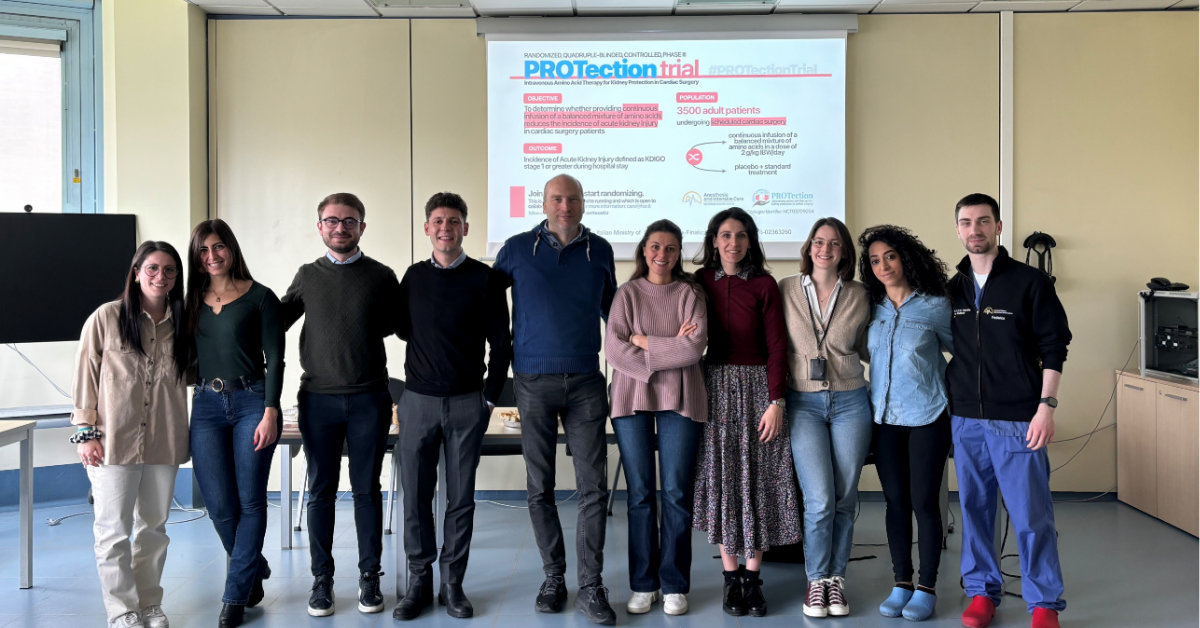
The most significant recent result from Landoni's research group is an article published in the New England Journal of Medicine in 2024. It describes a new clinical protocol based on the intravenous infusion of an amino acid mixture capable of preventing acute kidney injury.
«For the first time in the history of medicine, we have found a method to protect the kidneys: a short intravenous infusion of an amino acid mixture can reduce renal stress during cardiopulmonary bypass in major cardiac surgery». This result has contributed to reshaping international guidelines. It was achieved through the work of senior clinicians, residents, and a medical student who was completing their thesis at the time - and who is now a resident in the programme Landoni directs.
Open questions for the next generation of researchers
What remains to be discovered in anaesthesiology and intensive care? According to Landoni, among the many unresolved questions, two stand out. The first concerns anaesthesia itself. «We still do not know which anaesthetic agent is best for our patients, and we are talking about more than 300 million people a year who undergo major surgery» he explains.
The second concerns what is known as the reperfusion paradox: organs suffer during ischaemia (the reduction or interruption of blood flow) but, counterintuitively, they suffer even more when blood flow is restored. How to protect the brain, the heart, and other organs after cardiac arrest, cardiopulmonary bypass, or transplantation remains an open question. Restoring blood flow is not enough: timing and technique make all the difference. «I hope the next generation of anaesthesiologists will find us an answer» Landoni concludes.
Written by

UniSR Communication Team
Thanks to the contribution of the various team members, the UniSR Marketing and Communications Service deals with the multiple communication areas of the University: news scouting, creation of news, audio and video, event organization, website management and institutional social media, drafting and publication of newsletters, support for institutional relations. The Service interacts with all the main stakeholders (students, teachers, technical and administrative staff, research community, territory) in order to support and potential communication (internal and external) of the initiatives related to teaching, research and public engagement.
Visit the author's page